
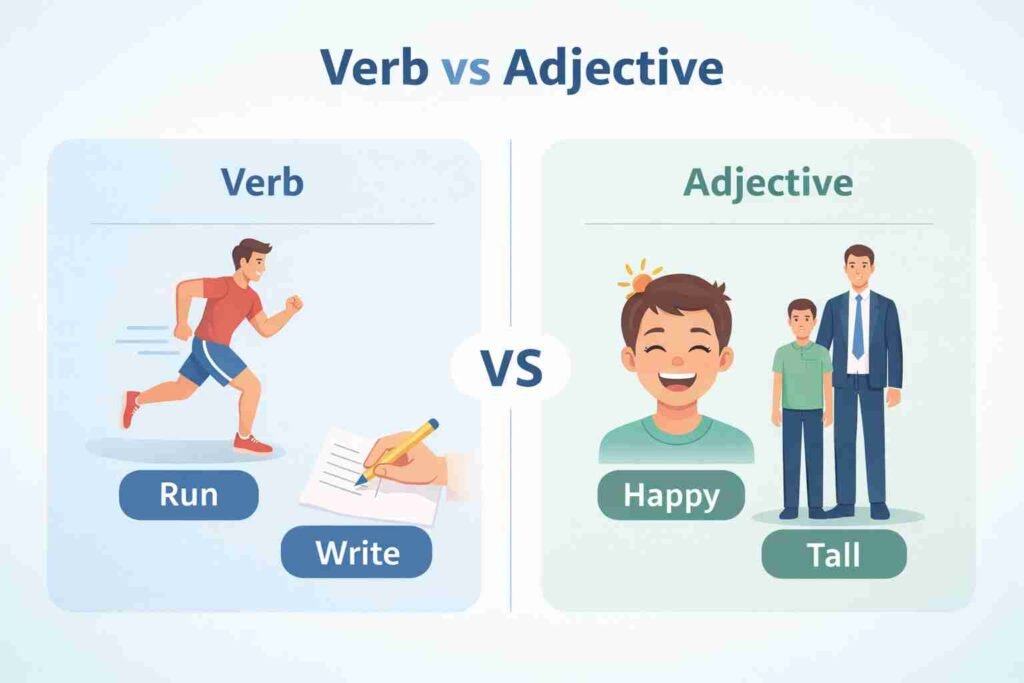
Definition
A verb shows action or a state of being, while an adjective describes or modifies a noun. Verbs tell what happens and adjectives tell what something is like. Understanding the difference between verb vs adjective improves grammar, writing clarity and sentence structure.
Grammar is the foundation of clear communication. Two of the most important parts of speech in English are verbs and adjectives. They appear in almost every sentence we speak or write. Yet many learners confuse them, especially when words look similar or change form.
For example, in the sentence “She runs fast,” runs is a verb. In “She is fast,” fast is an adjective. The meaning changes based on how the word functions in the sentence.
Understanding verb vs adjective is essential for building correct sentences. It helps in writing essays, speaking confidently, and avoiding common grammar mistakes. You are a student, a professional, or someone improving English skills, mastering the difference between verbs and adjectives strengthens your communication.
In this guide, we will explore definitions, examples, comparisons, real world usage, common mistakes, exercises, and frequently asked questions. By the end, you will clearly understand how verbs and adjectives work and how to use them correctly.
Quick Overview
The main difference between verb vs adjective lies in their function.
A verb expresses an action or a state of being.
An adjective describes a noun or pronoun.
| Feature | Verb | Adjective |
|---|---|---|
| Function | Shows action or state | Describes a noun |
| Answers | What is happening | What kind or which one |
| Example | She runs | She is happy |
| Position | After subject | Before noun or after linking verb |
Simple rule:
If the word tells what someone does, it is likely a verb.
If it describes what something is like, it is likely an adjective.
Definition and Explanation
What Is a Verb
A verb is a word that shows action or a state of being. Every complete sentence needs a verb. Without a verb, a sentence is incomplete.
Examples of action verbs
- eat
- write
- play
- run
Example sentences
- They play football.
- She writes a letter.
Verbs can also show a state of being. These are called linking verbs.
Examples
- is
- am
- are
- was
- were
Example sentence
- She is tired.
Here, is connects the subject to a description.
What Is an Adjective
An adjective is a word that describes a noun or pronoun. It gives more information about size, color, shape, quality, or condition.
Examples
- tall
- beautiful
- fast
- intelligent
Example sentences
- He is tall.
- They bought a new car.
In both cases, tall and new describe nouns.
How Verb vs Adjective Works in Sentences
Understanding sentence structure helps clarify the difference between verb vs adjective.
Example 1
She looks happy.
Looks is the verb.
Happy is the adjective describing she.
Example 2
She smiles happily.
Smiles is the verb.
Happily is an adverb describing the verb.
This shows how verbs and adjectives work together but have different roles.
Types of Verbs
To fully understand verb vs adjective, it is helpful to know the types of verbs.
Action Verbs
These show physical or mental action.
Examples
- run
- think
- write
Linking Verbs
These connect the subject to a description.
Examples
- is
- seem
- become
Example
He became angry.
Here, became is the verb. Angry is the adjective describing he.
Helping Verbs
These assist main verbs.
Examples
- has
- have
- will
- can
Example
She has finished her work.
Types of Adjectives
Adjectives also have categories.
Descriptive Adjectives
Describe qualities.
Example
- smart student
Quantitative Adjectives
Show amount.
Example
- many books
Demonstrative Adjectives
Point to specific nouns.
Example
- this house
Possessive Adjectives
Show ownership.
Example
- my bag
Advantages of Understanding Verb vs Adjective
- Improves sentence accuracy
- Reduces grammar mistakes
- Enhances writing clarity
- Strengthens communication skills
- Helps in academic and professional writing
When learners clearly understand verb vs adjective, they avoid confusion and build stronger sentences.
Common Confusing Cases
Some words can act as both verbs and adjectives depending on usage.
Example 1
Clean
Verb
Please clean your room.
Adjective
Your room is clean.
Example 2
Open
Verb
Open the door.
Adjective
The door is open.
This flexibility often causes confusion in verb vs adjective identification.
Real World Examples
In Education
Students writing essays must use verbs for action and adjectives for description. Incorrect usage can lower grades.
In Business Communication
Emails require correct grammar.
Incorrect
The report complete.
Correct
The report is complete.
In Public Speaking
Clear grammar improves confidence and professionalism.
Regional and Global Usage
English is spoken worldwide, but grammar usage remains consistent across regions. However, learning patterns vary.
North America and Europe
Grammar education strongly focuses on identifying verbs and adjectives early in school. Standard grammar rules apply in formal writing and communication.
South Asia
Students often learn English as a second language. Verb tense usage can be more challenging than adjective placement.
East Asia
Grammar drills and structured learning emphasize verb conjugation and adjective usage.
Global Digital Communication
With social media growth, informal language sometimes ignores grammar rules. However, academic and professional writing still demands correct verb vs adjective usage.
Understanding grammar differences globally improves cross cultural communication and academic success.
Common Mistakes
| Mistake | Why It Is Wrong | Correct Version |
|---|---|---|
| She very happy | Missing verb | She is very happy |
| He quick runs | Wrong word order | He runs quickly |
| The sky blue | Missing linking verb | The sky is blue |
| They success | Noun used wrongly | They succeed |
Many errors happen because learners confuse verbs, adjectives, and adverbs.
Verb vs Adjective Comparison Table
| Aspect | Verb | Adjective |
|---|---|---|
| Role | Shows action or state | Describes noun |
| Required in sentence | Yes | Not always |
| Changes with tense | Yes | No |
| Example | She sings | She is happy |
This table highlights the structural difference clearly.
Exercises with Answers
Exercise 1 Identify the Part of Speech
- The dog runs fast.
- The dog is fast.
- She feels tired.
- They work hard.
Answers
- Runs is a verb
- Fast is an adjective
- Feels is a verb, tired is an adjective
- Work is a verb
Exercise 2 Fill in the Blank
- She ___ intelligent.
- They ___ football every day.
- The food tastes ___.
Answers
- is
- play
- delicious
Related Concepts
Verb vs Adverb
Verb shows action.
Adverb describes a verb.
Example
She runs quickly.
Runs is verb.
Quickly describes how she runs.
Adjective vs Adverb
Adjective describes noun.
Adverb describes verb.
Example
He is quick.
He runs quickly.
Understanding these relationships prevents confusion in grammar learning.
Advanced Understanding
Participles
Some verb forms act like adjectives.
Example
The broken chair
Broken comes from the verb break but functions as an adjective.
Linking Verbs and Predicate Adjectives
Example
The sky is blue.
Blue is an adjective connected by linking verb is.
These structures are important in advanced grammar studies.
FAQs
What is the main difference between verb and adjective?
A verb shows action or state, while an adjective describes a noun or pronoun.
Can a word be both a verb and an adjective?
Yes. Words like clean and open can function as either depending on context.
Does every sentence need a verb?
Yes. A complete sentence must contain at least one verb.
Can a sentence have more than one adjective?
Yes. For example, She bought a beautiful red dress.
How do linking verbs relate to adjectives?
Linking verbs connect the subject to an adjective, such as She is happy.
Are adjectives required in every sentence?
No. A sentence can exist without adjectives, but not without verbs.
How can I easily identify a verb?
Ask what action is happening or what state is being described.
How can I identify an adjective?
Ask what kind, which one, or how many about a noun.
Do verbs change with tense?
Yes. Verbs change form to show time. Adjectives do not.
Why is understanding verb vs adjective important?
It improves grammar accuracy, writing clarity, and professional communication.
Conclusion
Understanding verb vs adjective is essential for clear and effective communication. Verbs express action or state of being, while adjectives describe nouns and provide detail. Without verbs, sentences are incomplete. Without adjectives, sentences lack richness and description.
Recognizing how they function within a sentence improves writing accuracy and reduces grammar mistakes. In academic writing, professional communication, or daily conversation, proper usage of verbs and adjectives strengthens clarity and confidence.
Practice identifying verbs and adjectives in daily reading. Write simple sentences and analyze their structure. With consistent learning and application, mastering verb vs adjective becomes natural and automatic.

Christopher Hayes is a passionate language enthusiast and the lead content creator at TalkNexs.com, a platform dedicated to helping readers master the art of grammar, writing and effective communication. With years of experience in writing, editing and teaching language, Christopher’s mission is to make grammar simple, practical and engaging for everyone.