
Definition
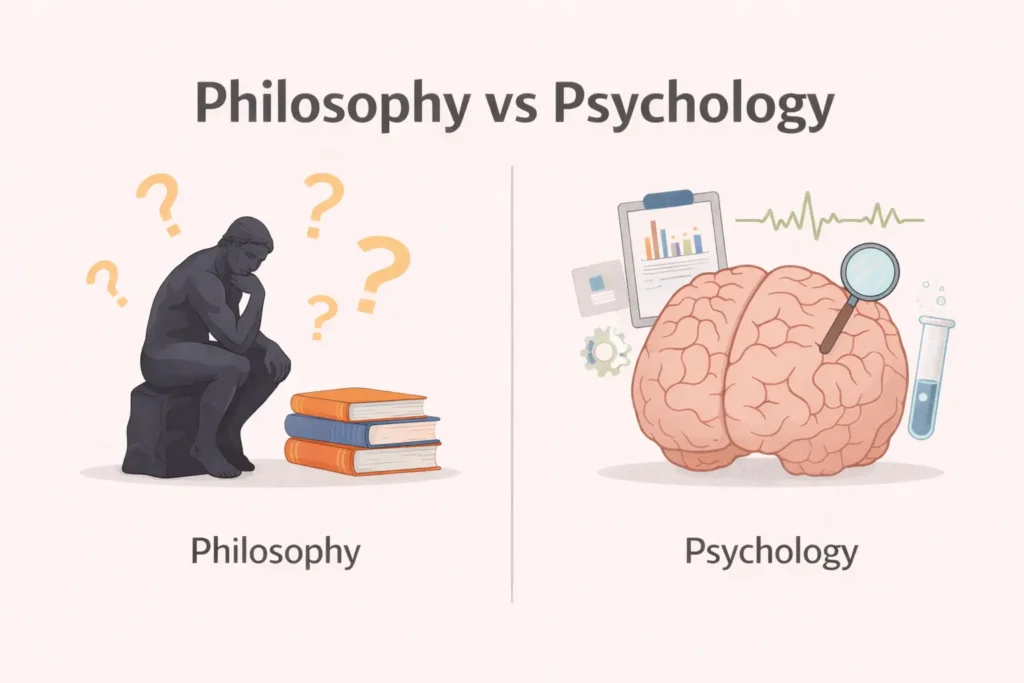
Philosophy and psychology both study the human mind and behavior, but they approach it differently. Philosophy explores fundamental questions about existence, knowledge, and morality through reasoning, while psychology studies thoughts and behavior using scientific research and observation. Understanding philosophy vs psychology helps clarify how we think, feel, and make decisions.
Many people confuse philosophy and psychology because both explore the human mind. Both ask deep questions about thinking, emotions, behavior, and meaning. Yet they are not the same field.
Philosophy is one of the oldest academic disciplines. It asks big questions such as What is truth? What is reality? What is right or wrong? It uses logic and reasoning to search for answers.
Psychology, on the other hand, is a scientific study of the mind and behavior. It uses experiments, data, and observation to understand how people think, feel, and act.
Understanding the difference between philosophy vs psychology is important for students, researchers, and professionals. It helps you choose the right academic path, understand how knowledge is formed, and apply insights to real life. This article explains their definitions, similarities, differences, advantages, global use, and practical examples in a clear and simple way.
Quick Overview
Philosophy focuses on abstract thinking and reasoning.
Psychology focuses on scientific study and measurable behavior.
| Feature | Philosophy | Psychology |
|---|---|---|
| Nature | Theoretical and abstract | Scientific and experimental |
| Focus | Truth, ethics, knowledge, existence | Behavior, emotions, cognition |
| Method | Logical reasoning and argument | Research, data, observation |
| Origin | Ancient discipline | Modern science |
| Career Paths | Ethics, teaching, law | Therapy, counseling, research |
Definition and Explanation
What Is Philosophy
Philosophy is the study of fundamental questions about life, existence, knowledge, morality, and reasoning. The word comes from Greek and means love of wisdom.
Philosophy asks questions such as:
- What is reality
- What is knowledge
- What makes actions right or wrong
- Do humans have free will
Philosophy does not rely on experiments. Instead, it uses logical argument, discussion, and critical thinking. Major branches of philosophy include:
- Metaphysics which studies reality and existence
- Epistemology which studies knowledge and truth
- Ethics which studies morality
- Logic which studies reasoning
Philosophy builds the foundation for many other fields, including science and psychology.
What Is Psychology
Psychology is the scientific study of the mind and behavior. It examines how people think, feel, and act. Unlike philosophy, psychology uses experiments, statistics, and research methods to test ideas.
Psychology studies topics such as:
- Memory
- Emotions
- Personality
- Mental disorders
- Learning
- Brain function
There are different branches of psychology:
- Clinical psychology
- Cognitive psychology
- Social psychology
- Developmental psychology
- Industrial organizational psychology
Psychology aims to understand behavior and improve mental health through scientific evidence.
Historical Background
Philosophy is older than psychology. Ancient thinkers like Plato and Aristotle discussed the mind long before psychology existed as a science.
In the 19th century, psychology separated from philosophy and became an independent discipline. It began using laboratory experiments to study mental processes.
For centuries, philosophy explored the mind through reasoning. Later, psychology developed tools to measure thoughts and behavior scientifically. This historical link explains why philosophy vs psychology often overlap.
Key Differences Between Philosophy and Psychology
Approach to Knowledge
Philosophy uses reasoning and debate. It asks whether ideas make logical sense.
Psychology uses experiments and evidence. It tests ideas with data.
Methodology
Philosophy does not require laboratory testing. It relies on structured arguments.
Psychology depends on measurable data, surveys, brain imaging, and experiments.
Goal
Philosophy seeks wisdom and understanding.
Psychology seeks explanation and practical solutions.
Application
Philosophy influences ethics, politics, and logic.
Psychology helps in therapy, education, business, and healthcare.
Similarities Between Philosophy and Psychology
Despite differences, philosophy and psychology share common ground.
- Both study the human mind
- Both explore behavior and decision making
- Both examine emotions and consciousness
- Both influence education and personal development
Many psychological theories have philosophical roots. Questions about free will, identity, and morality exist in both fields.
Advantages and Disadvantages
Philosophy Advantages
- Develops strong critical thinking skills
- Encourages deep reasoning
- Helps clarify moral values
- Strengthens argument and debate abilities
Philosophy Disadvantages
- Abstract and sometimes impractical
- Hard to measure or test conclusions
- Career paths may be less direct
Psychology Advantages
- Based on scientific evidence
- Offers practical solutions
- Wide career opportunities
- Direct impact on mental health
Psychology Disadvantages
- Research may change over time
- Requires strict scientific training
- Ethical concerns in experiments
Real World Examples
Example 1: Free Will
Philosophy asks whether humans truly have free will.
Psychology studies how decisions are influenced by unconscious processes.
Example 2: Happiness
Philosophy explores what happiness means and whether it is the ultimate goal of life.
Psychology measures happiness using surveys and brain studies.
Example 3: Morality
Philosophy debates what is right or wrong.
Psychology studies how moral decisions develop in children.
Regional and Global Usage
Philosophy and psychology are studied worldwide, but their emphasis varies by region.
North America
Psychology is highly developed in the United States and Canada. Research universities focus on neuroscience, cognitive science, and therapy. Philosophy departments often specialize in ethics, political theory, and analytic philosophy.
Europe
European countries have strong traditions in both fields. Germany and France contributed major philosophical movements. The United Kingdom has leading psychology research institutions.
Asia
In countries like Japan, China, and India, philosophy includes traditional systems of thought such as Confucianism and Buddhist philosophy. Psychology is growing rapidly, especially in clinical and educational fields.
Middle East
Philosophy has historical roots in Islamic scholarship. Modern psychology is expanding through university programs and mental health awareness campaigns.
Global Trend
Globally, psychology is expanding due to demand for mental health services. Philosophy remains important in ethics, artificial intelligence debates, and education.
Common Mistakes
1 Mistake: Thinking philosophy and psychology are the same
Correction: Philosophy uses reasoning. Psychology uses science.
Mistake 2: Believing philosophy has no practical value
Correction: Philosophy shapes ethics, law, and policy.
3 Mistake: Assuming psychology answers moral questions
Correction: Psychology explains behavior but does not define moral truth.
4 Mistake: Thinking psychology is only therapy
Correction: Psychology includes research, business, education, and neuroscience.
Related Concepts and Comparisons
Philosophy vs Psychology vs Sociology
| Feature | Philosophy | Psychology | Sociology |
|---|---|---|---|
| Focus | Ideas and truth | Mind and behavior | Society and groups |
| Method | Reasoning | Scientific testing | Social research |
| Level | Individual and abstract | Individual | Group and social |
Psychology vs Philosophy in Education
Philosophy of education defines what education should achieve.
Educational psychology studies how students learn best.
Exercises with Answers
Exercise 1
Identify whether the statement belongs to philosophy or psychology.
- What is justice
- How does memory work
- Do humans have free will
- How does trauma affect behavior
Answers:
- Philosophy
- Psychology
- Philosophy
- Psychology
Exercise 2
Match the field to the method.
| Method | Field |
|---|---|
| Logical reasoning | Philosophy |
| Laboratory experiment | Psychology |
| Ethical debate | Philosophy |
| Behavioral observation | Psychology |
Career Paths Comparison
Philosophy Careers
- Law
- Ethics consulting
- Teaching
- Policy analysis
- Writing
Psychology Careers
- Clinical psychologist
- Counselor
- Research scientist
- Human resources specialist
- Organizational consultant
Psychology often requires advanced degrees and licenses. Philosophy careers may require additional specialization such as law school.
FAQs
What is the main difference between philosophy vs psychology?
Philosophy relies on reasoning and argument, while psychology relies on scientific research and data.
Can psychology exist without philosophy?
No. Psychology developed from philosophical questions about the mind.
Is philosophy more difficult than psychology?
Both are challenging in different ways. Philosophy requires deep reasoning. Psychology requires scientific analysis.
Which is better for a career, philosophy or psychology?
Psychology offers more direct career paths in healthcare. Philosophy provides flexible skills useful in law, writing, and ethics.
Do philosophers study behavior?
Yes, but through reasoning rather than experiments.
Is psychology a science?
Yes. Psychology uses research methods and statistical analysis.
Can someone study both philosophy and psychology?
Yes. Many universities offer joint programs.
Does psychology answer moral questions?
No. Psychology explains behavior. Philosophy evaluates morality.
Which field studies consciousness?
Both philosophy and psychology explore consciousness, but with different methods.
Is philosophy still relevant today?
Yes. Philosophy influences debates on artificial intelligence, ethics, politics, and human rights.
Conclusion
Philosophy vs psychology represents two powerful approaches to understanding the human mind. Philosophy asks fundamental questions about truth, morality, and existence through logical reasoning. Psychology studies thoughts and behavior through scientific research and evidence.
Both fields complement each other. Philosophy builds the foundation of ideas, while psychology tests those ideas in real life. Together, they help us understand human nature, decision making, emotions, and ethical responsibility.
If you seek deep thinking and abstract reasoning, philosophy may be your path. If you prefer scientific methods and practical application, psychology may suit you better. Understanding their differences allows you to choose wisely and appreciate the value of both disciplines in shaping modern knowledge.
Discover More Related Articles:
- Dysphasia vs Dysphagia Symptoms: How to Tell Them Apart in 2026
- Dodge vs Ford SUVs: Performance, Comfort and Value Breakdown in 2026
- Esthetics vs Aesthetics: Why Both Spellings Exist in 2026

David Thompson is the grammar expert behind TalkNexs.com. He believes that learning English grammar doesn’t have to be boring or complicated. Through practical examples and easy explanations, David helps readers understand confusing grammar rules and use them correctly in daily communication. His goal is to make grammar simple, clear and enjoyable for everyone.