Definition
Dreads and braids are two distinct protective hairstyles with different structures and care methods. Dreads form through matting and locking of hair over time, while braids are created by weaving sections of hair in patterns. Understanding the difference between dreads vs braids helps you choose the right style for your hair type, lifestyle and cultural preference.
Hairstyles are more than fashion. They reflect culture, identity, and personal expression. Among the most popular protective styles are dreads and braids. Many people confuse these two styles because both involve sectioned hair and can last for weeks or months. However, they are very different in structure, maintenance, and long-term commitment.
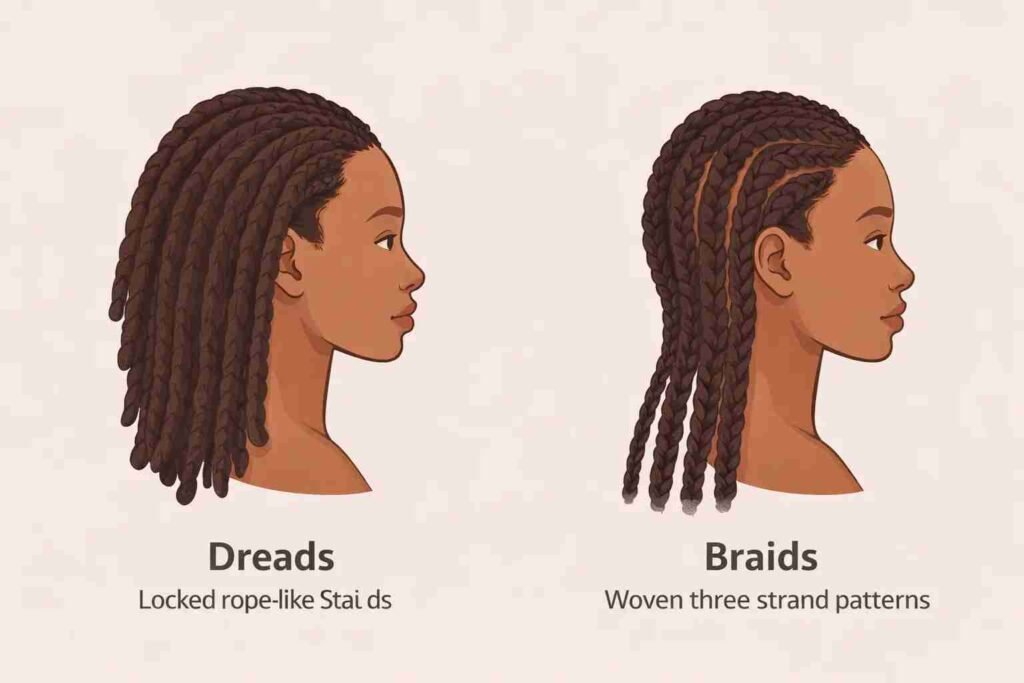
Dreads, also known as dreadlocks or locs, form when hair strands lock and mat together naturally or with guidance. Braids, on the other hand, are created by weaving three or more strands of hair into patterns. Both styles protect hair from daily manipulation, but they require different care routines and levels of commitment.
Understanding the difference between dreads vs braids is important before making a decision. This guide explains definitions, benefits, drawbacks, real-world examples, global usage, maintenance routines, common mistakes, and frequently asked questions.
Quick Overview
Dreads and braids differ in formation, longevity, maintenance, and reversibility.
| Feature | Dreads | Braids |
|---|---|---|
| Structure | Locked, matted hair | Woven strands |
| Duration | Long-term or permanent | Temporary |
| Reversible | Difficult | Easily removable |
| Maintenance | Retwisting, locking care | Regular rebraiding |
| Cultural Roots | Ancient spiritual traditions | African heritage and global styles |
Definition and Explanation
What Are Dreads
Dreads, also called locs, are formed when hair strands tangle and lock together. This can happen naturally over time or through methods like twisting, palm rolling, or interlocking. Once formed, the hair remains locked unless cut or professionally undone.
Dreads can be thin, thick, long, or short. They may take months to mature fully. During this process, the hair goes through stages such as starter locs, budding, and mature locs.
What Are Braids
Braids are created by weaving sections of hair together. The most common method involves dividing hair into three strands and crossing them over each other repeatedly. Braids can also include extensions for added length and volume.
Common braid styles include box braids, cornrows, French braids, and feed-in braids. Unlike dreads, braids do not permanently change the structure of the hair. They can be removed easily after a few weeks.
Structural Differences
The core difference in dreads vs braids lies in how the hair is structured.
Dreads rely on natural matting and locking. Hair strands fuse together and form a unified rope-like structure.
Braids depend on weaving patterns. The strands remain separate and do not permanently combine.
This structural difference impacts maintenance, appearance, and long-term hair health.
Advantages and Disadvantages
Advantages of Dreads
- Low daily styling effort once mature
- Long-lasting and durable
- Can grow very long over time
- Often require fewer daily products
Disadvantages of Dreads
- Long-term commitment
- Can be difficult to remove
- May require patience during early stages
- Incorrect maintenance can cause buildup
Advantages of Braids
- Versatile styling options
- Temporary and reversible
- Protective for natural hair
- Suitable for short-term fashion changes
Disadvantages of Braids
- Tension may cause hair breakage
- Require reinstallation every few weeks
- Can be time-consuming to install
- Improper tightness may damage edges
Maintenance and Care
Maintenance differs significantly in dreads vs braids.
Caring for Dreads
- Wash regularly using residue-free shampoo
- Retwist new growth every few weeks
- Avoid heavy conditioners
- Keep scalp clean and moisturized
Mature locs often need less manipulation than starter locs.
Caring for Braids
- Clean scalp gently with diluted shampoo
- Moisturize scalp with light oil
- Avoid excessive tension
- Remove after six to eight weeks
Braids should not be left in too long, as this can lead to tangling and breakage.
Real World Examples
Teenagers often choose braids during school breaks because they are temporary and stylish. Professionals may choose neat braids or mature locs for low-maintenance daily routines.
Athletes prefer braids or locs because they keep hair secure during physical activity. Artists and performers may choose locs for long-term identity expression.
In fashion industries, braids frequently change based on trends, while locs represent a more consistent personal style.
Cultural and Historical Background
The conversation around dreads vs braids cannot ignore history. Both styles have deep cultural roots.
Braids have existed for over 5,000 years in African cultures. They often represented crew, age, marital status, and social rank. Cornrows, for example, were used as both cultural symbols and practical hairstyles.
Dreads have spiritual and cultural significance in various traditions. In Hindu culture, sadhus wear matted hair as a symbol of renunciation. In Rastafarian culture, locs represent spiritual belief and connection to identity.
Today, both styles are worn globally, but understanding their origins promotes cultural respect.
Regional and Global Usage
Africa
Braids remain a central cultural practice. Skilled braiders create intricate patterns that reflect tradition and artistry. Locs are also common and symbolize spiritual or lifestyle choices.
North America
Both styles are popular protective hairstyles. Braids are often chosen for versatility. Locs are increasingly accepted in professional settings. Legal protections in some regions now prevent discrimination based on natural hairstyles.
Europe
Braids are widely used for fashion and protective styling. Locs are less common but growing in popularity among diverse communities.
Caribbean
Locs are strongly connected to Rastafarian identity. Braids are also common for both cultural and practical reasons in tropical climates.
Asia
Braids are more common as fashion trends, while locs are less widespread but present in urban style communities.
Globally, social media has increased awareness of both hairstyles and proper maintenance techniques.
Common Mistakes
- Choosing dreads without understanding long-term commitment
- Installing braids too tightly, causing tension alopecia
- Neglecting scalp hygiene
- Using heavy wax in locs, leading to buildup
- Leaving braids installed beyond recommended time
Avoiding these mistakes protects hair health and ensures better results.
Exercises with Answers
Exercise 1
Identify whether the hairstyle described is dreads or braids.
- Hair strands permanently locked together.
- Three sections woven into a pattern.
- Requires retwisting new growth.
- Can be removed after six weeks.
Answers
- Dreads
- Braids
- Dreads
- Braids
Exercise 2
Match the feature to the correct style.
| Feature | Dreads | Braids |
|---|---|---|
| Long-term commitment | Yes | No |
| Temporary style | No | Yes |
| Requires weaving | No | Yes |
| Forms through locking | Yes | No |
Related Comparisons
dreadlocks vs braids vs Twists
Twists are created by wrapping two strands around each other. They are temporary like braids but have a softer appearance.
Dreads vs Braids for Hair Growth
Both styles protect hair from breakage. Growth depends on scalp health and maintenance rather than the style itself.
Dreads vs Braids for Different Hair Types
Coily and textured hair forms locs more easily. Braids can be installed on various hair types, often with extensions for support.
FAQs
What is the main difference between dreads vs braids?
Dreads involve locked hair strands, while braids are woven patterns that remain separate and temporary.
Are dreads permanent?
Dreads are considered long-term. They can be removed, but the process is difficult and time-consuming.
How long do braids last?
Most braids last four to eight weeks depending on care and hair growth.
Do dreads damage hair?
Properly maintained locs do not damage hair. Poor hygiene or tight styling can cause issues.
Are braids protective?
Yes, braids protect hair from daily manipulation and environmental stress.
Can you wash dreads and braids?
Yes, both should be washed regularly to maintain scalp health.
Which is better for hair growth, dreads or braids?
Neither directly increases growth. Both help retain length by reducing breakage.
Are dreads culturally sensitive?
Yes, locs have cultural and spiritual significance in many communities. Understanding this promotes respect.
Do braids cause hair loss?
Tight braids can cause tension alopecia. Proper installation prevents this issue.
Can you switch from braids to dreads?
Yes, braids can transition into starter locs through locking techniques.
Conclusion
Dreads and braids are both protective hairstyles, but they differ greatly in structure, maintenance, and commitment level. Dreads form through locking and represent a long-term style choice, often connected to cultural or spiritual identity. Braids are woven patterns that offer versatility and temporary protection.
When choosing between dreads vs braids, consider your lifestyle, hair type, maintenance preference, and personal expression. If you prefer flexibility and frequent style changes, braids may be ideal. If you want a lasting, low-daily-maintenance style with cultural depth, locs may be suitable.
Healthy scalp care, proper installation, and regular maintenance are essential for both styles. By understanding the differences, benefits and responsibilities of each option, you can confidently select the hairstyle that aligns with your needs and identity.

David Thompson is the grammar expert behind TalkNexs.com. He believes that learning English grammar doesn’t have to be boring or complicated. Through practical examples and easy explanations, David helps readers understand confusing grammar rules and use them correctly in daily communication. His goal is to make grammar simple, clear and enjoyable for everyone.