Definition
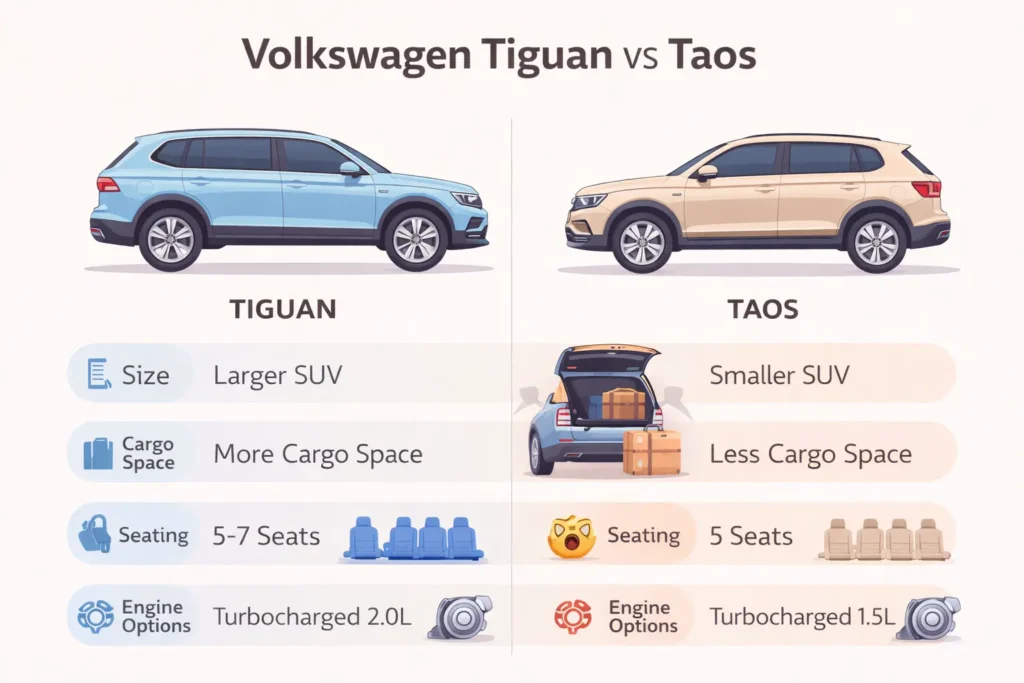
The Volkswagen Tiguan and Taos are two compact SUVs designed for comfort, performance and technology. Tiguan is larger with more cargo space and advanced features, while Taos is smaller, more affordable and ideal for city driving. Understanding their differences helps buyers choose the best SUV for their needs.
Choosing the right compact SUV can be challenging with so many options available in today’s market. Among Volkswagen’s lineup, the Tiguan and Taos are two of the most popular choices. Both vehicles offer modern design, advanced technology and comfortable interiors, but they are targeted at slightly different audiences.
The Tiguan is larger and offers three rows of seating in some trims, making it a family-friendly option. The Taos is smaller, more budget-friendly, and designed for efficient urban and suburban driving. Many buyers get confused between the two due to their similar branding, but understanding their differences is essential for making an informed decision.
This article will compare the Volkswagen Tiguan vs Taos in terms of size, performance, features, fuel economy, technology, safety, pricing, regional popularity, and more. By the end, readers will have a clear understanding of which SUV fits their lifestyle and budget.
Quick Overview
| Feature | Volkswagen Tiguan | Volkswagen Taos |
|---|---|---|
| Vehicle Type | Compact SUV | Subcompact SUV |
| Seating | 5-7 passengers | 5 passengers |
| Cargo Space | 37.6 to 73.5 cu. ft. | 25.9 to 65.9 cu. ft. |
| Engine | 2.0L Turbocharged 4-cylinder | 1.5L Turbocharged 4-cylinder |
| Horsepower | 184-221 hp | 158 hp |
| Transmission | 8-speed automatic | 8-speed automatic |
| Drivetrain | FWD / AWD | FWD / AWD |
| Fuel Economy | 21-28 MPG city/highway | 25-31 MPG city/highway |
| Starting Price | Around $30,000 | Around $24,000 |
| Advanced Features | Optional 3rd-row, digital cockpit, adaptive cruise | Modern infotainment, city safety features |
Design and Interior
Tiguan
The Tiguan is slightly larger than the Taos, with a bold front grille, sharp LED headlights, and a more premium overall look. Inside, it offers spacious seating, high-quality materials, and optional third-row seating. Cargo space ranges from 37.6 to 73.5 cubic feet depending on seating configuration, making it suitable for families and long trips.
Taos
The Taos is smaller, designed for urban driving, but still features a modern and stylish exterior. The interior is practical, with comfortable seating for five and cargo space from 25.9 to 65.9 cubic feet. While it lacks a third row, it provides smart storage solutions, user-friendly infotainment, and high-quality materials in higher trims.
Performance and Engine Comparison
| Feature | Tiguan | Taos |
|---|---|---|
| Engine Type | 2.0L Turbocharged 4-cylinder | 1.5L Turbocharged 4-cylinder |
| Horsepower | 184-221 hp | 158 hp |
| Torque | 221-258 lb-ft | 184 lb-ft |
| 0-60 mph | ~7.8-8.2 sec | ~7.5-8.0 sec |
| Transmission | 8-speed automatic | 8-speed automatic |
| Drivetrain Options | FWD, 4Motion AWD | FWD, AWD |
Tiguan offers stronger engine options, providing better acceleration, towing capability, and highway performance. Taos focuses on efficiency and city-friendly driving, making it lighter on fuel consumption while still providing responsive performance.
Fuel Economy
- Tiguan: 21 MPG city / 28 MPG highway (FWD), slightly lower with AWD
- Taos: 25 MPG city / 31 MPG highway (FWD), slightly lower with AWD
The Taos provides better fuel economy due to its smaller engine and lighter frame, making it ideal for daily commuting and urban driving. The Tiguan’s larger engine offers more power but consumes more fuel, especially with AWD or full passenger loads.
Technology and Features
Both vehicles offer modern technology, but Tiguan emphasizes premium features, while Taos focuses on efficiency and convenience:
Tiguan
- Volkswagen Digital Cockpit
- Adaptive Cruise Control
- 8-inch or 10.25-inch infotainment touchscreen
- Apple CarPlay and Android Auto
- Optional third-row seating
- Advanced driver-assistance features
Taos
- 8-inch touchscreen infotainment
- Apple CarPlay and Android Auto
- Forward collision warning with automatic emergency braking
- Lane keeping assist
- Adaptive cruise (available on higher trims)
- Smaller, more streamlined feature set compared to Tiguan
Safety
Volkswagen prioritizes safety in both SUVs:
| Safety Feature | Tiguan | Taos |
|---|---|---|
| Forward Collision Warning | Yes | Yes |
| Automatic Emergency Braking | Yes | Yes |
| Blind Spot Monitoring | Yes | Yes |
| Lane Keeping Assist | Yes | Yes |
| Rear Traffic Alert | Yes | Yes |
| Crash Test Ratings | 5-star NHTSA | 5-star NHTSA (expected) |
Both SUVs provide modern safety features, but Tiguan’s higher trims include more advanced systems like adaptive headlights and parking assist.
Pricing Comparison
| Trim Level | Tiguan Starting Price | Taos Starting Price |
|---|---|---|
| Base | $30,000 | $24,000 |
| Mid | $33,000 | $27,000 |
| High | $39,000 | $32,000 |
Tiguan is more expensive due to its larger size, additional features, and optional third-row seating. Taos is budget-friendly, appealing to younger buyers or city dwellers seeking a compact SUV without premium pricing.
Regional and Global Usage
North America
In the United States and Canada, Tiguan is popular among families needing extra space and advanced features. Taos appeals to first-time SUV buyers and commuters who prioritize fuel efficiency and affordability.
Europe
Tiguan is widely sold in Europe, often in high-spec trims with diesel and AWD options. Taos is newer in the European market, marketed as a practical and affordable urban SUV.
Asia
Both models are available in China and Southeast Asia, with Tiguan being favored for larger families and premium features, while Taos targets young professionals and city drivers.
Global Trend
Globally, compact SUVs are growing in popularity due to their versatility, fuel efficiency, and technology. Tiguan fits the premium family SUV segment, while Taos captures the urban, budget-friendly market.
Common Mistakes Buyers Make
- Confusing size and capacity: Some buyers choose Taos expecting third-row seating, which it does not have.
- Underestimating fuel economy differences: Tiguan consumes more fuel, especially in AWD.
- Overlooking features: Higher trims of Tiguan offer features not available in Taos, which may affect convenience and resale value.
- Misjudging handling: Taos is lighter and easier for city driving, Tiguan provides stability for highway and off-road driving.
Exercises with Answers
Exercise 1: Identify which SUV is better for each scenario.
- A family of five needing extra space for trips.
- A young professional commuting daily in the city.
- A buyer prioritizing fuel efficiency.
- Someone seeking advanced driver-assistance features.
Answers:
- Tiguan
- Taos
- Taos
- Tiguan
Exercise 2: Match features to the SUV.
| Feature | Tiguan | Taos |
|---|---|---|
| Third-row seating | Yes | No |
| Higher towing capacity | Yes | No |
| Budget-friendly pricing | No | Yes |
| City-friendly size | No | Yes |
Related Comparisons
- Tiguan vs Honda CR-V: Tiguan offers more premium features, CR-V has slightly better reliability.
- Taos vs Mazda CX-30: Taos is more affordable, Mazda CX-30 has sportier handling.
- Tiguan vs Taos vs Atlas: Atlas is larger, Tiguan is mid-size, Taos is subcompact.
FAQs
Which SUV is bigger, Tiguan or Taos?
The Tiguan is larger, offers more interior space, and can have a third-row seat.
Which SUV is more fuel-efficient?
The Taos is more fuel-efficient due to its smaller engine and lighter weight.
Which SUV is better for families?
Tiguan is better for families needing more seating and cargo space.
Which SUV is more affordable?
Taos is more budget-friendly and ideal for first-time SUV buyers.
Does Tiguan offer AWD?
Yes, Tiguan offers FWD and optional 4Motion all-wheel drive.
Does Taos offer a third row?
No, Taos only seats five passengers.
Which SUV has better technology features?
Tiguan offers more advanced features, especially in higher trims, including a digital cockpit and adaptive cruise control.
Are both SUVs safe?
Yes, both Tiguan and Taos have high safety ratings and modern driver-assistance features.
Which SUV is easier to park in the city?
Taos, due to its smaller size, is easier to maneuver in urban settings.
Can Taos handle highway driving comfortably?
Yes, Taos performs well on highways but offers less power compared to Tiguan.
Conclusion
The Volkswagen Tiguan and Taos cater to different needs within the compact SUV segment. Tiguan is larger, more powerful, and offers advanced features and optional third-row seating, making it ideal for families and longer trips. Taos is smaller, more efficient and budget-friendly, perfect for city driving and commuters.
Understanding the differences in size, performance, features, fuel economy, and pricing helps buyers choose the right SUV for their lifestyle. Tiguan provides premium comfort and capability, while Taos offers practicality, efficiency and affordability. Both SUVs maintain Volkswagen’s reputation for quality, safety, and modern technology.
By analyzing your priorities, it is space, budget, fuel efficiency or features, you can make an informed choice between the Volkswagen Tiguan and Taos.
Discover More Related Articles:
- Moonstone vs Opal: Which Gemstone Is More Valuable and Why in 2026
- Hashimoto vs Graves Disease: Which Thyroid Condition Is It? in 2026
- P790 vs P770: Which Taylor Made Iron Is Better for Your Golf Game? in 2026

David Thompson is the grammar expert behind TalkNexs.com. He believes that learning English grammar doesn’t have to be boring or complicated. Through practical examples and easy explanations, David helps readers understand confusing grammar rules and use them correctly in daily communication. His goal is to make grammar simple, clear and enjoyable for everyone.