
Definition
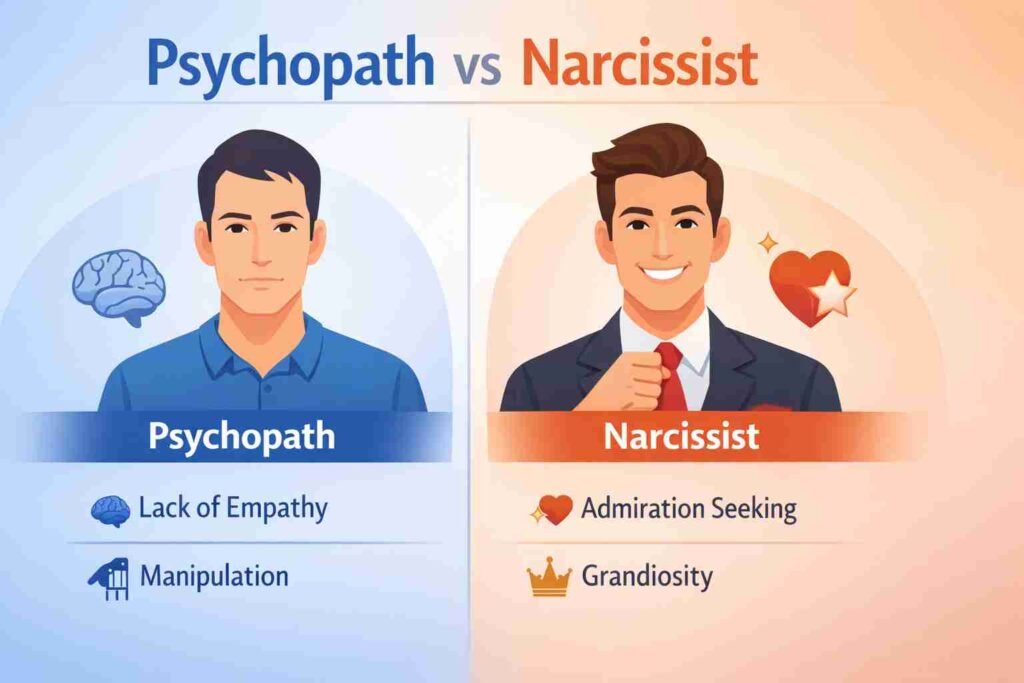
Psychopath and narcissist are both personality types often linked with manipulation and lack of empathy, but they are not the same. A psychopath shows persistent antisocial behavior and emotional detachment, while a narcissist is driven by excessive self-importance and a need for admiration. Understanding the difference helps in recognizing patterns of behavior and setting appropriate boundaries.
The terms psychopath and narcissist are often used interchangeably in everyday conversation. Movies, television, and social media frequently blur the distinction, creating confusion about what each term actually means. While both personality types can display manipulative or harmful behavior, their motivations, emotional patterns, and psychological foundations are different.
Psychopathy is generally associated with antisocial behavior, shallow emotions, and lack of remorse. Narcissism, on the other hand, centers around grandiosity, entitlement, and an intense need for admiration. Both can create challenges in personal, professional, and social relationships.
Clear understanding of psychopath vs narcissist helps in identifying behavioral red flags, improving awareness, and making informed decisions in social interactions. This article explains definitions, traits, causes, comparisons, real-world examples, global perspectives, and frequently asked questions in a structured and professional manner.
Quick Overview
Psychopath and narcissist differ mainly in emotional depth, behavioral patterns, and motivations.
| Feature | Psychopath | Narcissist |
|---|---|---|
| Core Trait | Antisocial behavior | Grandiosity |
| Empathy Level | Very low or absent | Limited, self-centered |
| Emotional Depth | Shallow emotions | Emotionally reactive |
| Motivation | Control and dominance | Admiration and validation |
| Remorse | Rarely feels guilt | May feel shame if ego is hurt |
| Risk of Criminal Behavior | Higher likelihood | Lower, unless ego threatened |
Psychopathy is often linked to Antisocial Personality Disorder, while narcissism is associated with Narcissistic Personality Disorder.
Definition and Explanation
Psychopath
Psychopathy refers to a personality pattern characterized by persistent antisocial behavior, impulsivity, manipulation, and lack of empathy or remorse. Psychopaths often appear charming, confident, and calm under pressure. However, emotional depth is limited, and relationships are frequently transactional.
Psychopathy is not formally listed as a standalone diagnosis in many psychiatric manuals but is closely related to Antisocial Personality Disorder. Research suggests that approximately 1 percent of the general population may exhibit psychopathic traits, though higher rates are observed in prison populations.
Common traits of a psychopath include:
- Superficial charm
- Lack of guilt or remorse
- Manipulative tendencies
- Impulsivity
- Risk-taking behavior
- Emotional coldness
Psychopaths may function effectively in corporate or leadership settings due to confidence and fearlessness, but harmful behavior can emerge in personal relationships.
Narcissist
Narcissism refers to a personality pattern marked by grandiosity, need for admiration, and inflated self-importance. Narcissistic Personality Disorder is a recognized psychological condition affecting approximately 0.5 to 1 percent of the population.
Unlike psychopaths, narcissists often experience strong emotional reactions when their self-image is threatened. Beneath apparent confidence, there may be fragile self-esteem.
Common traits of a narcissist include:
- Exaggerated sense of importance
- Constant need for praise
- Sensitivity to criticism
- Sense of entitlement
- Lack of deep empathy
- Exploitative relationships
While narcissists may manipulate others, the motivation typically revolves around maintaining status and admiration rather than thrill or control.
Core Psychological Differences
Understanding psychopath vs narcissist requires examining emotional structure and behavioral patterns.
Emotional Processing
Psychopaths display shallow emotions. Fear, guilt, and empathy are significantly reduced. Emotional responses may be mimicked rather than genuinely felt.
Narcissists experience emotions intensely, particularly anger or shame when ego is challenged. Emotional volatility is more visible.
Relationship Patterns
Psychopaths treat relationships as opportunities for gain. Attachments are minimal and often short-lived.
Narcissists seek relationships that provide admiration, validation, or social status. Dependency on external praise is common.
Impulsivity and Risk
Psychopaths often engage in reckless or criminal behavior without remorse. Risk-taking is part of stimulation seeking.
Narcissists may avoid high-risk behavior unless self-image or dominance is threatened.
Advantages and Disadvantages
Psychopath
Advantages:
- High confidence
- Fearlessness under pressure
- Ability to make unemotional decisions
Disadvantages:
- Lack of empathy damages relationships
- Higher risk of criminal behavior
- Difficulty maintaining long-term trust
Narcissist
Advantages:
- Strong ambition
- Charismatic presentation
- Desire for achievement and recognition
Disadvantages:
- Fragile self-esteem
- Sensitivity to criticism
- Strained personal relationships
Real-World Examples
In workplace settings, a psychopathic leader may appear calm during crises and make bold decisions without emotional hesitation. However, such leadership may ignore ethical concerns or employee well-being.
A narcissistic manager may demand constant recognition, react strongly to criticism, and take credit for team achievements. Productivity may increase temporarily due to ambition, but morale may decline due to lack of empathy.
In personal relationships, a psychopath may manipulate without emotional attachment, while a narcissist may alternate between idealization and devaluation depending on perceived admiration.
Regional and Global Perspective
Psychopathy and narcissism are studied worldwide, but cultural norms influence how traits are perceived.
In Western societies, individualism may mask narcissistic traits as confidence or ambition. Competitive environments may reward grandiosity.
In collectivist cultures, overt narcissism may be socially discouraged, yet subtle forms of ego-centered behavior may persist.
Psychopathy research is often linked to criminal justice systems in North America and Europe, where antisocial traits are closely examined in forensic psychology.
Global mental health awareness has increased through academic research and digital education platforms. However, misuse of psychological labels remains common on social media. Not every difficult person qualifies as a psychopath or narcissist.
Common Mistakes in Understanding
- Assuming every manipulative person is a psychopath.
- Labeling confident individuals as narcissists.
- Confusing temporary selfish behavior with personality disorder.
- Using clinical terms casually without psychological assessment.
- Ignoring environmental and developmental factors.
Personality disorders require professional evaluation. Occasional selfishness or insensitivity does not automatically indicate psychopathy or narcissism.
Related Comparisons
Psychopath vs Sociopath
Psychopathy and sociopathy both relate to antisocial traits. Psychopathy is often associated with calculated behavior and emotional detachment, while sociopathy may involve impulsivity and emotional volatility.
Narcissist vs Borderline Personality
Narcissistic traits focus on grandiosity and admiration. Borderline personality patterns emphasize emotional instability and fear of abandonment.
Exercises with Answers
Exercise 1
Identify whether the behavior aligns more with psychopathy or narcissism.
- Lack of remorse after harming others.
- Extreme anger when criticized.
- Manipulates for thrill and control.
- Seeks constant admiration from peers.
Answers:
- Psychopath
- Narcissist
- Psychopath
- Narcissist
Exercise 2
Match the trait to the personality type.
| Trait | Psychopath | Narcissist |
|---|---|---|
| Shallow emotions | Yes | No |
| Fragile self-esteem | No | Yes |
| Criminal risk | Higher | Lower |
| Need for admiration | No | Yes |
FAQs
What is the main difference between psychopath and narcissist?
A psychopath shows antisocial behavior and emotional detachment, while a narcissist seeks admiration and maintains an inflated self-image.
Can a person be both a psychopath and a narcissist?
Some individuals may display traits of both, but clinical diagnosis requires professional evaluation.
Do psychopaths feel emotions?
Psychopaths experience limited emotional depth and reduced empathy.
Do narcissists feel guilt?
Narcissists may feel shame or anger when ego is threatened but often struggle with empathy.
Are psychopaths violent?
Not all psychopaths are violent, but research indicates higher risk of criminal or aggressive behavior.
Are narcissists dangerous?
Narcissistic behavior can damage relationships but does not always involve criminal actions.
Can therapy help psychopaths?
Treatment outcomes vary. Some therapeutic approaches focus on behavioral management rather than emotional change.
Can therapy help narcissists?
Therapy can help address fragile self-esteem and improve empathy if the individual is willing to participate.
Is narcissism always a disorder?
No. Narcissistic traits exist on a spectrum. Only severe, persistent patterns qualify as Narcissistic Personality Disorder.
Is psychopathy a medical diagnosis?
Psychopathy is closely linked to Antisocial Personality Disorder but is not always listed as a separate diagnosis in diagnostic manuals.
Prevention and Professional Guidance
Early behavioral intervention, structured environments, and psychological counseling may reduce harmful behavioral patterns. Awareness of red flags in relationships helps prevent emotional harm. Professional evaluation is essential before assigning clinical labels.
Research suggests that personality patterns are influenced by genetics, early childhood environment, trauma, and social learning. Early support systems may reduce severity of harmful traits.
Conclusion
Psychopath vs narcissist represents two distinct personality patterns often confused in everyday discussion. Psychopathy centers on antisocial behavior, emotional coldness, and lack of remorse. Narcissism focuses on grandiosity, need for admiration, and fragile self-esteem.
Although both personality types may display manipulative behavior, their motivations and emotional structures differ significantly. Recognizing these differences supports clearer understanding of behavior patterns in personal and professional settings.
Clinical diagnosis should be left to mental health professionals. Casual labeling may oversimplify complex psychological conditions. Informed awareness, professional guidance, and careful observation are essential when addressing psychopathic or narcissistic traits.

Christopher Hayes is a passionate language enthusiast and the lead content creator at TalkNexs.com, a platform dedicated to helping readers master the art of grammar, writing and effective communication. With years of experience in writing, editing and teaching language, Christopher’s mission is to make grammar simple, practical and engaging for everyone.