
Definition
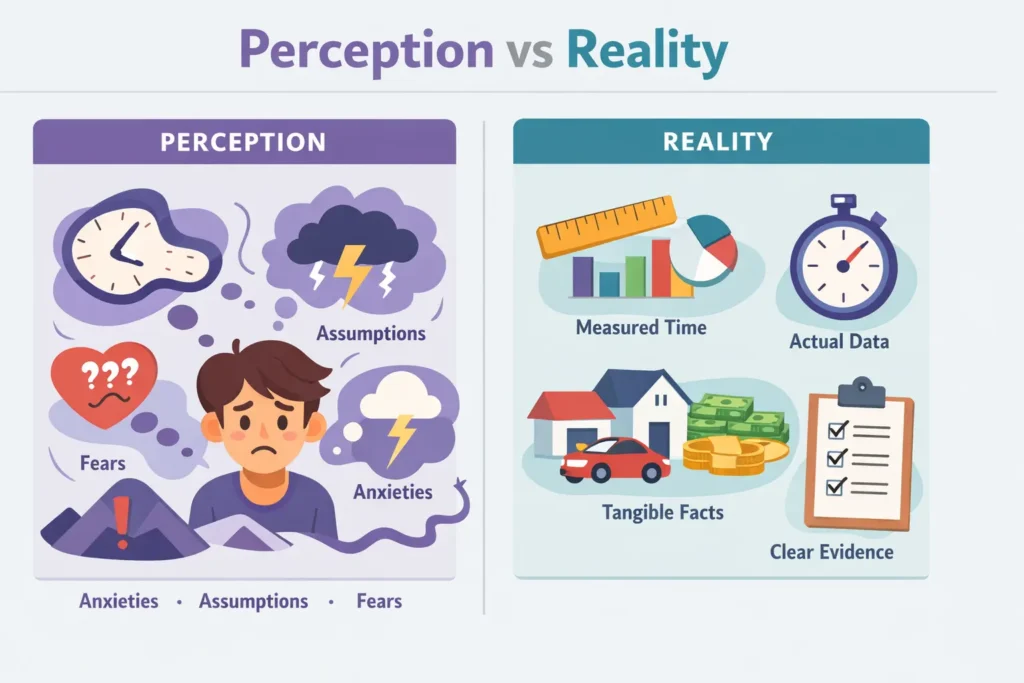
Perception vs reality refers to the difference between how people interpret situations and what actually exists objectively. Perception is shaped by experiences, beliefs and emotions, while reality represents facts and evidence that exist regardless of personal interpretation.
People often believe what they see or feel is the truth. However, human understanding of the world is not always accurate. Our minds interpret information through personal experiences, emotions and expectations. This interpretation forms our perception. Reality, on the other hand, is the actual state of things, independent of individual beliefs.
The gap between perception and reality affects many areas of life, including relationships, workplace communication, media consumption, and decision making. For example, someone may perceive criticism in a comment that was actually meant as helpful feedback. Similarly, a news headline might create a perception that differs from the full facts.
Learning the difference between perception vs reality helps people think more critically and respond more effectively in daily situations. It improves judgment, reduces conflict, and encourages evidence based thinking.
In this article, we will explore the meaning of perception and reality, their differences, real world examples, common misconceptions, global perspectives, and practical ways to recognize when perception may differ from reality.
Quick Overview
Perception and reality are closely connected but not always the same. Perception refers to how individuals interpret information through their senses and experiences. Reality refers to the objective truth that exists regardless of personal interpretation.
| Feature | Perception | Reality |
|---|---|---|
| Definition | Personal interpretation of events | Actual state of things |
| Influenced By | Experiences, emotions, beliefs | Facts and evidence |
| Nature | Subjective | Objective |
| Variability | Different for each person | Consistent regardless of opinion |
| Example | Thinking someone is angry | The person may simply be tired |
Understanding perception vs reality helps people analyze situations more accurately and avoid assumptions.
Definition and Explanation
Perception
Perception is the process through which the brain interprets information received through the senses. These senses include sight, sound, touch, taste, and smell. However, perception is not just about sensory input. It is also shaped by personal beliefs, cultural background, emotions, and past experiences.
For example, two people may witness the same event but interpret it differently. One person may see a situation as unfair, while another may view it as reasonable. Their perceptions are influenced by their individual perspectives.
Psychologists explain that perception is a mental shortcut. The brain quickly interprets information based on patterns it has learned before. While this helps humans respond quickly, it can sometimes lead to inaccurate conclusions.
Reality
Reality refers to the actual state of things as they exist. It includes facts, evidence, and events that occur regardless of how individuals interpret them.
Reality is independent of personal opinions or emotions. For instance, if a meeting begins at 10:00 AM, that time represents reality. Whether someone feels the meeting started early or late is their perception.
In science and research, reality is often verified through observation, measurement, and evidence. Objective methods help reduce bias and ensure conclusions are based on facts rather than personal interpretations.
Why the Difference Between Perception and Reality Matters
Understanding the gap between perception and reality is important for several reasons.
First, it helps improve decision making. People who rely only on perception may make choices based on incomplete or inaccurate information. Recognizing reality encourages careful evaluation of facts.
Second, it improves communication. Many conflicts arise because individuals interpret words or actions differently. Understanding that perception varies helps people clarify misunderstandings.
Third, it encourages critical thinking. Questioning whether a belief reflects perception or reality helps individuals analyze situations more thoughtfully.
Finally, recognizing the difference supports emotional intelligence. It allows people to pause before reacting and consider whether their interpretation matches the facts.
Advantages and Limitations of Perception
Perception is an essential part of human cognition. It allows individuals to interpret their surroundings and respond quickly to changes.
Advantages of Perception
• Helps humans react quickly to situations
• Allows individuals to interpret complex information
• Shapes personal identity and experiences
• Supports creativity and imagination
Limitations of Perception
• Can be influenced by bias and stereotypes
• May lead to misunderstandings
• Often shaped by incomplete information
• Can distort reality during emotional situations
Recognizing these limitations helps people question assumptions and verify information before forming conclusions.
Real World Examples of Perception vs Reality
Social Media
Social media often creates a perception that people live perfect lives. Photos and posts highlight positive moments such as travel, celebrations, or achievements. The reality is that everyone experiences challenges and setbacks that are not always visible online.
Workplace Communication
An employee may perceive a manager’s short message as rude or dismissive. The reality may simply be that the manager was busy or communicating quickly. Clarifying intent often resolves such misunderstandings.
Advertising
Marketing campaigns frequently influence perception. A product may appear highly effective in advertisements, creating a positive perception among consumers. However, the actual performance of the product represents reality, which may differ from the advertised image.
Personal Relationships
In relationships, one person may perceive neglect or disinterest based on limited interactions. The reality may be that the other person is dealing with personal stress or responsibilities.
These examples show how perception can differ significantly from actual circumstances.
Regional and Global Perspectives
The relationship between perception and reality can vary across cultures and societies. Cultural values, traditions, and communication styles influence how people interpret events.
Western Societies
In many Western cultures, individual perception is often emphasized. Personal opinions and interpretations are considered important in discussions and decision making. However, scientific methods and evidence based reasoning are also highly valued to establish objective reality.
Asian Societies
In several Asian cultures, collective perception plays a stronger role. Social harmony and group perspectives may influence how events are interpreted. Reality may be considered within the broader context of community and relationships.
Media Influence Worldwide
Global media significantly shapes perception. News coverage, online content, and entertainment influence how people understand events. However, media narratives may highlight certain aspects of reality while leaving out others.
This demonstrates that perception vs reality is not only a psychological concept but also a cultural and social phenomenon.
Common Mistakes When Confusing Perception and Reality
People often make errors when they assume their perception represents reality. Some common mistakes include:
Assuming personal feelings equal facts
Believing rumors without verifying information
Interpreting incomplete information as truth
Allowing stereotypes to shape judgment
Making decisions based on emotional reactions
Correcting these mistakes requires evidence based thinking and open communication.
Exercises with Answers
These exercises help reinforce the understanding of perception vs reality.
Exercise 1
Identify whether the statement represents perception or reality.
- The room temperature is 22 degrees Celsius.
- The room feels too cold.
- The meeting began at 9:30 AM.
- The meeting felt extremely long.
Answers
1 Reality
2 Perception
3 Reality
4 Perception
Exercise 2
Consider the following scenario.
A coworker does not greet you in the morning.
Question:
What might be the perception and what might be the reality?
Possible Answer
Perception: The coworker is upset or ignoring you.
Reality: The coworker may be distracted, tired, or focused on work.
Related Concepts and Comparisons
Understanding perception vs reality becomes easier when compared with related ideas.
| Concept | Description |
|---|---|
| Bias | A tendency to interpret information in a certain way |
| Perspective | A particular viewpoint shaped by experiences |
| Objectivity | Observing facts without personal influence |
| Subjectivity | Judging based on personal feelings or opinions |
These concepts highlight how human thinking can influence interpretation.
How to Align Perception with Reality
Several practical strategies help reduce the gap between perception and reality.
Seek evidence before forming conclusions.
Ask questions to clarify misunderstandings.
Consider alternative explanations for events.
Reflect on personal biases that may influence interpretation.
Use reliable sources when evaluating information.
These steps encourage more accurate understanding of situations.
FAQs
What is the main difference between perception and reality?
Perception refers to personal interpretation of events, while reality represents the objective facts that exist independently of opinions.
Why do perception and reality differ?
Perception is influenced by emotions, experiences, beliefs, and cultural background, which can alter how people interpret information.
Can perception ever match reality?
Yes. When people rely on evidence and clear observation, perception can closely reflect reality.
Why is perception important if reality is objective?
Perception shapes how individuals understand and respond to situations. It influences decisions, behavior, and communication.
How does media affect perception vs reality?
Media can shape perception by highlighting certain information while omitting other details, which may create an incomplete view of reality.
Is perception always wrong?
No. Perception can be accurate, but it is not always reliable without supporting evidence.
How can someone improve their understanding of reality?
By verifying facts, seeking multiple perspectives, and evaluating evidence before forming conclusions.
Do cultural differences affect perception?
Yes. Cultural values, traditions, and communication styles influence how people interpret events and information.
What role does psychology play in perception?
Psychology studies how the brain processes sensory information and how cognitive biases influence interpretation.
Why is understanding perception vs reality important in daily life?
It helps reduce misunderstandings, improve communication, and support better decision making.
Conclusion
Perception and reality are closely connected but not always identical. Perception represents how individuals interpret events based on experiences, emotions, and beliefs. Reality represents the objective facts that exist regardless of interpretation.
The difference between perception vs reality influences many aspects of life, including relationships, workplace communication, media understanding, and decision making. When individuals rely only on perception, misunderstandings can occur. By examining evidence and considering alternative viewpoints, people can better align their perceptions with reality.
Developing this awareness strengthens critical thinking and emotional intelligence. It encourages individuals to pause, reflect, and verify information before reacting. In an age where information spreads quickly through digital platforms, distinguishing between perception and reality is more important than ever.
By practicing thoughtful observation and evidence based reasoning, individuals can improve communication, reduce conflict, and make more informed decisions in everyday life.
Discover More Related Articles:
- Moles vs Freckles: What Your Skin Is Really Saying in 2026
- Hemorrhoids vs Fissure: How to Know Which One You Have in 2026
- Electrocardiogram vs Echocardiogram: What Each Heart Test Reveals in 2026

Jonathan Reed is a dedicated grammar expert and language researcher at TalkNexs.com. With a strong passion for English structure, clarity and effective communication, he has spent years helping students, writers and professionals improve their grammar skills in simple and practical ways.