
Definition
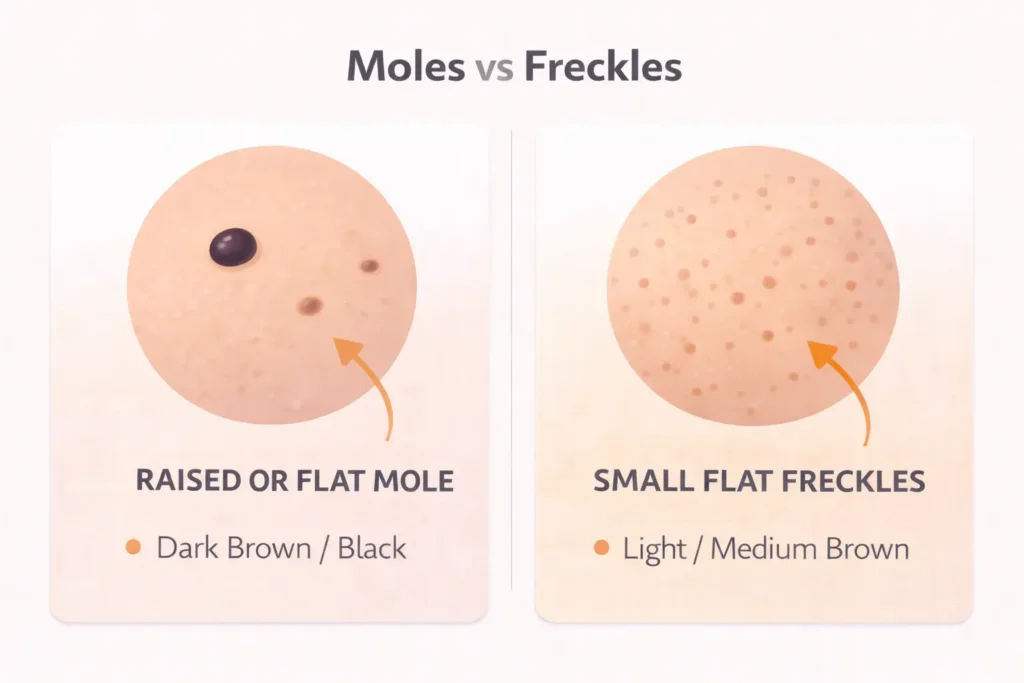
Moles and freckles are common skin markings but differ in appearance, cause and health implications. Moles are usually darker, raised, or pigmented spots, while freckles are small, flat, sun-induced spots. Knowing the difference helps in skin care and monitoring for potential skin problems.
Skin is the body’s largest organ and can reveal a lot about health and lifestyle. Moles and freckles are two of the most common skin features that many people notice, but they are often confused. While both appear as dark spots on the skin, their causes, formation and health implications are very different. “Moles vs Freckles.
Moles are usually caused by clusters of pigmented cells and can appear at birth or develop later in life. Some moles are harmless, while others may require monitoring for changes that could indicate skin cancer. Freckles, in contrast, are small, flat, brownish spots caused by sun exposure and genetic factors. “Moles vs Freckles.
Understanding the difference between moles and freckles is important for skin health, prevention of skin damage, and choosing appropriate skincare. In this article, we will explore definitions, causes, appearance, regional variations, prevention, treatment options, common mistakes, exercises, FAQs, and actionable tips for managing these skin features effectively. “Moles vs Freckles.
Quick Overview
| Feature | Moles | Freckles |
|---|---|---|
| Appearance | Dark brown or black, can be raised or flat | Light brown, flat, smaller |
| Cause | Cluster of pigment cells (melanocytes) | Increased melanin due to sun exposure, genetic predisposition |
| Onset | Can appear at birth or develop later | Usually appear in childhood, more visible with sun exposure |
| Health Concern | Some moles may become cancerous | Usually harmless, cosmetic concern only |
| Common Areas | Anywhere on body, often torso and face | Face, shoulders, arms |
| Treatment | Monitoring, removal if suspicious or cosmetic | Sun protection, topical fading creams if desired |
Definition and Explanation
Moles
Moles, also known as nevi, are clusters of pigmented cells called melanocytes. They can be flat or raised, round or oval, and vary in color from light brown to black. Moles may appear at birth, known as congenital moles, or develop during childhood and adulthood. Most moles are harmless, but changes in shape, size, color, or texture can indicate a risk for melanoma, a serious type of skin cancer.
Moles can be single or grouped, and some individuals develop multiple moles across the body. While some are genetic, others may form due to sun exposure.
Freckles
Freckles, also called ephelides, are small, flat brownish spots that appear on sun-exposed areas of the skin. They are caused by increased melanin production due to ultraviolet (UV) exposure and are influenced by genetics. Unlike moles, freckles are usually not raised and do not carry a risk of skin cancer.
Freckles are more common in individuals with fair skin and light hair and often become darker or more numerous after sun exposure. While they are primarily cosmetic, excessive sun exposure can increase the risk of skin damage and skin cancer over time.
Contributing Factors and Causes
Causes of Moles
- Genetics: Family history of moles can increase likelihood.
- Sun Exposure: UV radiation may trigger mole development.
- Hormonal Changes: Puberty, pregnancy, and hormonal treatments can cause new moles to form.
- Age: Moles often appear in childhood and adolescence and may change over time.
Causes of Freckles
- Sun Exposure: UV radiation triggers melanin production.
- Genetics: People with fair skin, red hair, or light eyes are more prone.
- Seasonal Changes: Freckles may fade in winter and become more prominent in summer.
Appearance and Characteristics
| Feature | Moles | Freckles |
|---|---|---|
| Size | Can range from a few millimeters to larger than a centimeter | Small, usually 1-2 mm |
| Shape | Round or oval | Round or irregular but flat |
| Texture | Flat or raised, sometimes hairy | Always flat |
| Color | Light brown, dark brown, black, reddish | Light brown to dark brown |
| Change Over Time | Can change in size, shape, or color | Usually stable, may darken with sun exposure |
Key Tip: A mole that changes rapidly, bleeds, or becomes irregular should be examined by a dermatologist immediately.
Regional and Global Usage
Moles and freckles are common worldwide, but prevalence and perception vary based on skin types, cultural preferences, and sun exposure.
North America and Europe
Freckles are often seen as a cosmetic feature, especially in lighter-skinned individuals. Many people use sunscreen and lightening creams to reduce their appearance. Moles are closely monitored for potential skin cancer risks. Dermatologists recommend regular self-exams and professional check-ups.
Asia
Freckles are less common in East Asian populations due to darker skin pigmentation. Cosmetic treatments for freckles, such as laser therapy and chemical peels, are popular in countries like South Korea and Japan. Moles are monitored for both health and cosmetic reasons.
Africa and Middle East
Freckles are rare in individuals with darker skin tones, and sun protection is critical to prevent hyperpigmentation and skin damage.
Latin America
Freckles and moles are common in individuals with mixed skin tones. Sun exposure plays a major role in freckle development, and public awareness campaigns often focus on sunscreen and early detection of suspicious moles.
Globally, education about sun protection and mole monitoring is increasing, driven by dermatologists, public health campaigns, and social media. Teledermatology allows people worldwide to identify concerning moles and receive guidance remotely.
Common Mistakes in Management
- Ignoring Changes in Moles: Some moles can become cancerous. Regular monitoring is essential.
- Excessive Sun Exposure: Freckles darken and may indicate UV damage; using sunscreen is vital.
- Overusing Lightening Products: Harsh bleaching creams can irritate skin or cause pigmentation issues.
- Confusing Moles and Freckles: Mistaking a changing mole for a harmless freckle can delay detection of melanoma.
- Unprofessional Removal: Attempting to remove moles at home is dangerous; professional care is necessary.
Exercises with Answers
Exercise 1: Identify moles or freckles based on descriptions.
- Small, flat, brown spots on cheeks that darken in summer.
- Raised, dark brown spot on the torso appearing in teenage years.
- Tiny, flat spots on the shoulders that appear after sun exposure.
- Dark, slightly raised spot with a hair growing from it.
Answers:
- Freckles
- Mole
- Freckles
- Mole
Exercise 2: Match care strategies to the type.
| Strategy | Moles | Freckles |
|---|---|---|
| Regular monitoring for changes | Yes | No |
| Sunscreen application | Yes | Yes |
| Laser removal for cosmetic reasons | Yes | Yes |
| Avoid unprofessional extraction | Yes | No |
Prevention and Care
Moles
- Perform monthly self-exams to check for new or changing moles.
- Use broad-spectrum sunscreen to reduce UV-induced changes.
- Consult a dermatologist for suspicious moles.
- Avoid picking, scratching, or attempting home removal.
Freckles
- Apply sunscreen daily to prevent darkening.
- Wear protective clothing and hats when outdoors.
- Avoid tanning beds and excessive sun exposure.
Regular skin care and sun protection are the most effective ways to manage freckles and reduce mole-related risks.
Related Concepts and Comparisons
| Feature | Moles | Freckles | Age Spots |
|---|---|---|---|
| Appearance | Dark brown or black, flat or raised | Light brown, flat | Brown, flat, appear after age 40 |
| Cause | Pigment cell clusters | Sun exposure and genetics | UV exposure over time |
| Health Risk | Potential melanoma | None | Low, cosmetic concern |
| Treatment | Monitoring, removal if needed | Sun protection, lightening | Laser or topical treatments |
FAQs
What is the difference between moles and freckles?
Moles are clusters of pigment cells that can be flat or raised, while freckles are small, flat spots caused by sun exposure and genetics.
Are moles dangerous?
Most moles are harmless, but changes in color, size, or shape may indicate melanoma. Professional evaluation is important.
Can freckles turn into moles?
No, freckles do not turn into moles. They are separate skin features caused by different mechanisms.
How can I prevent freckles from darkening?
Apply broad-spectrum sunscreen, wear protective clothing, and avoid excessive sun exposure.
Do moles require removal?
Moles usually do not require removal unless they are suspicious, changing, or for cosmetic reasons.
Can freckles be removed?
Freckles are harmless and usually do not require removal. Cosmetic treatments include laser therapy, chemical peels, and topical creams.
When should I see a dermatologist?
Any mole that changes in size, color, or shape, bleeds, or becomes painful should be evaluated.
Are moles genetic?
Yes, genetics can influence the number and type of moles a person has.
Can tanning increase moles or freckles?
Yes, UV exposure can darken freckles and contribute to mole formation or changes.
Do children develop moles or freckles more often?
Freckles commonly appear in childhood, while moles can appear at birth or develop during adolescence.
Conclusion
Moles and freckles are common skin features that differ in cause, appearance, and health implications. It can be flat or raised and may carry a small risk of cancer, while freckles are flat, harmless spots caused by sun exposure and genetics. “Moles vs Freckles.
Proper identification, sun protection, and regular monitoring are key to maintaining healthy skin. Preventive measures, such as daily sunscreen, professional skin check-ups and avoiding unprofessional mole removal, help reduce risks and preserve skin health. “Moles vs Freckles.
Cosmetic treatments are available for those who wish to lighten freckles or remove moles for appearance. Understanding these differences ensures safer, healthier skin and better long-term outcomes. “Moles vs Freckles.
Discover More Related Articles:
- P790 vs P770: Which Taylor Made Iron Is Better for Your Golf Game? in 2026
- Tiguan vs Taos: Which Volkswagen SUV Should You Choose? in 2026
- Titanium vs Tungsten: Which Metal Is Best for Jewelry and Rings? in 2026

David Thompson is the grammar expert behind TalkNexs.com. He believes that learning English grammar doesn’t have to be boring or complicated. Through practical examples and easy explanations, David helps readers understand confusing grammar rules and use them correctly in daily communication. His goal is to make grammar simple, clear and enjoyable for everyone.