Definition
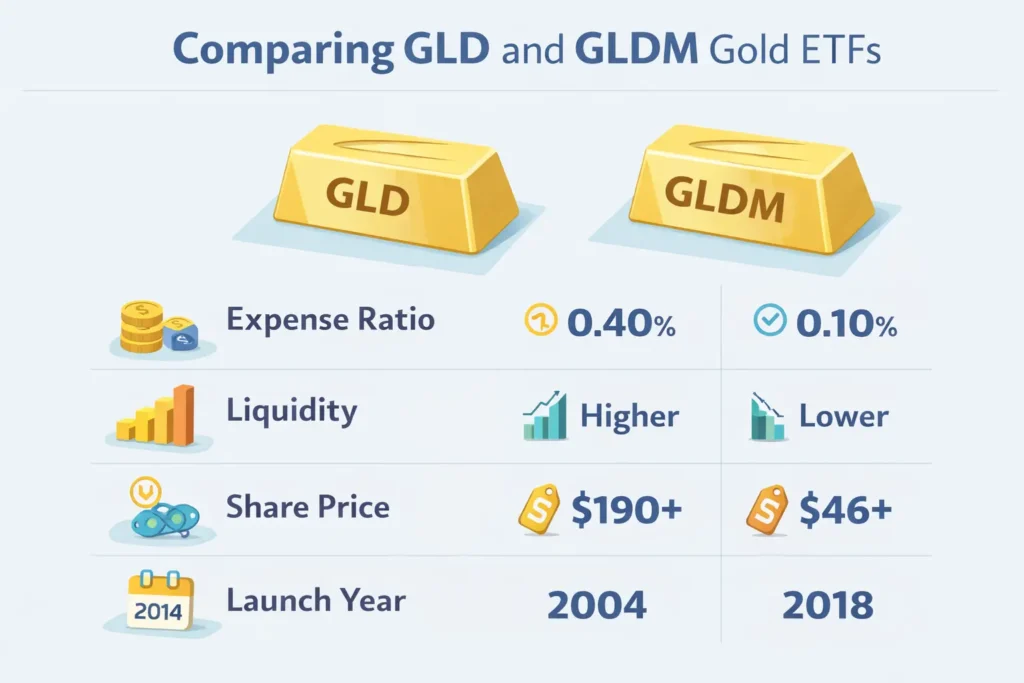
GLD and GLDM are exchange traded funds that track the price of gold. The main difference is cost and structure. GLDM usually has a lower expense ratio and smaller share price, while GLD is larger, older, and more widely traded.
Gold has long been considered a reliable store of value. Investors often use gold to protect wealth during inflation, economic uncertainty, or market volatility. In modern financial markets, many investors gain exposure to gold through exchange traded funds rather than buying physical gold bars or coins.
Two of the most well known gold ETFs are GLD and GLDM. Both funds are designed to track the price of gold and provide investors with an easy way to invest in the precious metal through stock exchanges. However, although they appear similar at first glance, there are important differences between them.
Investors frequently ask whether GLD or GLDM is the better option. The answer depends on several factors such as trading volume, expense ratio, long term holding strategy, and portfolio goals.
In this guide, we will explore GLD vs GLDM in detail. You will learn what these funds are, how they work, their advantages and disadvantages, and which one may fit your investment strategy better.
Quick Answer and Overview
GLD and GLDM both track the price of gold and hold physical gold bars in secure vaults. They are managed by the same asset manager and provide nearly identical exposure to gold prices.
The main difference is that GLDM is designed as a lower cost version of GLD.
| Feature | GLD | GLDM |
|---|---|---|
| Fund Name | SPDR Gold Shares | SPDR Gold MiniShares Trust |
| Launch Year | 2004 | 2018 |
| Expense Ratio | Higher | Lower |
| Share Price | Higher | Lower |
| Trading Volume | Very high | Moderate |
| Investor Type | Institutional and active traders | Long term retail investors |
In simple terms, GLD offers high liquidity and large trading volume, while GLDM provides a more cost efficient option for long term investors.
What Is GLD
GLD is one of the largest and most popular gold exchange traded funds in the world. It was launched in 2004 and revolutionized gold investing by allowing investors to buy gold exposure through stock markets.
Each share of GLD represents fractional ownership of physical gold stored in secure vaults.
Key characteristics of GLD include
- Tracks the price of gold
- Backed by physical gold bars
- Highly liquid with large daily trading volume
- Widely used by institutional investors and traders
GLD is often considered the benchmark gold ETF. Many hedge funds, banks, and financial institutions trade GLD because of its strong liquidity.
What Is GLDM
GLDM is another gold ETF created by the same sponsor. It was launched in 2018 as a lower cost alternative to GLD.
GLDM also holds physical gold in vaults and tracks the gold price in the same way as GLD. However, the structure was designed to reduce operating costs and make the ETF more accessible to retail investors.
Key characteristics of GLDM include
- Tracks the price of gold
- Backed by physical gold
- Lower expense ratio compared to GLD
- Smaller share price
- Designed for long term investors
Because of its lower cost structure, GLDM is becoming increasingly popular among investors who want affordable gold exposure.
Key Differences Between GLD and GLDM
Although both funds invest in gold, they differ in several important areas.
| Category | GLD | GLDM |
|---|---|---|
| Expense Ratio | Slightly higher | Lower |
| Liquidity | Very high | Moderate |
| Trading Volume | Extremely high | Lower but growing |
| Share Price | Higher | Lower |
| Launch Date | 2004 | 2018 |
| Investor Preference | Traders and institutions | Long term retail investors |
Expense Ratio
Expense ratio represents the annual management cost of holding the ETF.
GLDM has a lower expense ratio compared to GLD. Over many years, this difference can slightly improve investment returns.
Liquidity
GLD has extremely high trading volume. This means it is easier to buy and sell large positions quickly.
GLDM has lower volume but still offers adequate liquidity for most retail investors.
Share Price
GLDM typically trades at a lower share price than GLD. This makes it easier for small investors to buy multiple shares.
Advantages and Disadvantages
Advantages of GLD
- Extremely liquid
- Tight bid ask spreads
- Trusted by large institutions
- Long history and proven performance
Disadvantages of GLD
- Higher expense ratio compared to GLDM
- Higher share price
Advantages of GLDM
- Lower expense ratio
- Smaller share price
- Efficient for long term investment
Disadvantages of GLDM
- Lower trading volume
- Slightly wider spreads during trading
Real World Investment Examples
Example 1: Long Term Investor
Sarah wants to invest in gold as a hedge against inflation. She plans to hold the investment for ten years.
Because expense ratios matter more for long term investors, GLDM may be a better option for her.
Example 2: Active Trader
Michael trades frequently and buys and sells gold ETFs several times per month.
He prefers GLD because its high liquidity allows quick transactions with minimal price difference.
Example 3: Portfolio Diversification
A financial advisor building a diversified portfolio might allocate five percent to gold using GLDM because of its lower cost.
Regional and Global Usage
Gold ETFs are popular worldwide. Investors from different regions use them to protect wealth and diversify portfolios.
North America
In the United States and Canada, GLD is one of the most actively traded commodity ETFs. Institutional investors frequently use GLD for short term trading and hedging.
GLDM is becoming more popular among individual investors who want lower fees.
Europe
European investors often use gold ETFs as protection against currency fluctuations and inflation. Many brokerage platforms provide access to both GLD and GLDM.
Asia
Countries such as India and China have strong cultural connections with gold. While physical gold remains popular, digital investment through gold ETFs is growing quickly.
Global Trend
The global gold ETF market has grown significantly over the past decade. Investors increasingly prefer ETFs because they eliminate the need to store and secure physical gold.
Common Mistakes Investors Make
Many investors misunderstand how gold ETFs work. Some common mistakes include
Buying without understanding fees
Ignoring expense ratios for long term investing
Confusing liquidity with long term performance
Assuming gold ETFs pay dividends
Correct understanding of these factors can help investors choose the right ETF.
Exercises With Answers
Exercise 1
Identify which ETF fits the following situations.
1 Investor wants the lowest management fees
2 Investor trades gold ETFs frequently
3 Investor prefers higher liquidity
Answers
1 GLDM
2 GLD
3 GLD
Exercise 2
Fill in the correct ETF.
| Situation | Best ETF |
|---|---|
| Long term holding | GLDM |
| Short term trading | GLD |
| Institutional trading | GLD |
| Cost sensitive investor | GLDM |
Related Concepts and Comparisons
Understanding GLD vs GLDM becomes easier when compared with other gold investment options.
Physical Gold vs Gold ETFs
| Feature | Gold ETF | Physical Gold |
|---|---|---|
| Storage | No storage required | Requires storage |
| Liquidity | Easy to trade | Harder to sell quickly |
| Cost | Expense ratio | Storage and insurance |
| Accessibility | Stock exchange | Jewelry shops or bullion dealers |
Gold ETFs vs Gold Mining Stocks
Gold mining stocks represent companies that produce gold. Their performance depends not only on gold prices but also company operations.
Gold ETFs like GLD and GLDM track the price of gold directly, making them simpler investments.
FAQs
What is the difference between GLD and GLDM?
GLD and GLDM both track the price of gold, but GLDM usually has a lower expense ratio while GLD has higher liquidity.
Is GLDM better than GLD?
For long term investors focused on lower costs, GLDM may be better. Traders may prefer GLD because of its high liquidity.
Do GLD and GLDM hold physical gold?
Yes. Both funds are backed by physical gold stored in secure vaults.
Which ETF is cheaper to hold long term?
GLDM typically has a lower expense ratio, making it more cost efficient for long term investors.
Do GLD or GLDM pay dividends?
No. Gold ETFs generally do not pay dividends because they track the price of gold rather than income producing assets.
Can beginners invest in GLDM?
Yes. GLDM is designed to be accessible for individual investors due to its lower share price.
Are GLD and GLDM safe investments?
They are considered relatively safe compared to many assets because they track gold prices, but they still carry market risk.
Which ETF has higher trading volume?
GLD has significantly higher trading volume compared to GLDM.
Do GLD and GLDM track gold accurately?
Yes. Both funds are designed to closely follow the price of gold.
Can investors hold GLD or GLDM in retirement accounts?
Yes. Many brokerage platforms allow investors to hold gold ETFs in retirement or tax advantaged accounts.
Conclusion
GLD and GLDM are two of the most widely used gold ETFs available to investors today. Both funds provide exposure to the price of gold and hold physical gold in secure vaults. This makes them convenient alternatives to purchasing and storing physical gold.
The primary differences between GLD and GLDM relate to cost and liquidity. GLD offers extremely high trading volume and tight spreads, making it attractive for traders and institutional investors. GLDM, on the other hand, was designed to provide a lower expense ratio and a smaller share price, which makes it appealing for long term investors.
Choosing between GLD and GLDM depends on investment goals. Traders who value liquidity may prefer GLD, while investors focused on minimizing fees over time may benefit from GLDM.
Understanding these differences helps investors make informed decisions and use gold ETFs effectively within a diversified investment portfolio.
Discover More Related Articles:
- Moles vs Freckles: What Your Skin Is Really Saying in 2026
- Hemorrhoids vs Fissure: How to Know Which One You Have in 2026
- Electrocardiogram vs Echocardiogram: What Each Heart Test Reveals in 2026

Christopher Hayes is a passionate language enthusiast and the lead content creator at TalkNexs.com, a platform dedicated to helping readers master the art of grammar, writing and effective communication. With years of experience in writing, editing and teaching language, Christopher’s mission is to make grammar simple, practical and engaging for everyone.