
Definition
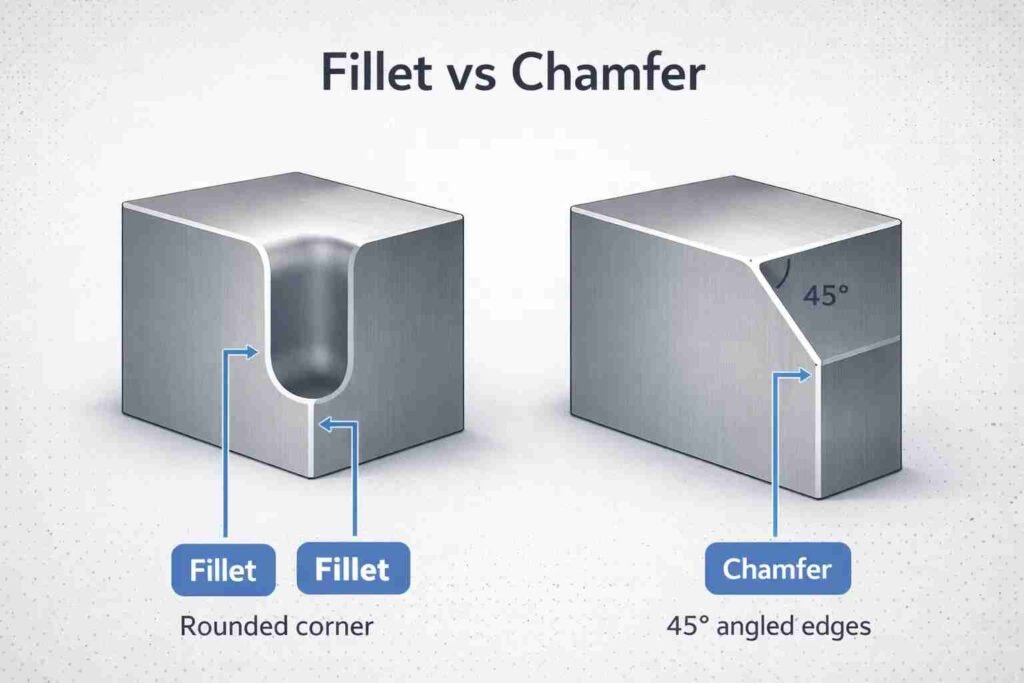
Fillet and chamfer are two common edge treatments used in engineering and manufacturing. A fillet creates a rounded internal or external corner, while a chamfer creates a straight, angled edge. Understanding the difference between fillet vs chamfer helps improve product strength, safety, appearance and manufacturability.
In engineering, design, and manufacturing, small details often make a big difference. One such detail is how edges and corners are finished. Two of the most commonly used edge treatments are fillet and chamfer. Although they may look similar at first glance, they serve different purposes and are applied in different situations.
A fillet creates a smooth, rounded corner between two surfaces. A chamfer, on the other hand, cuts the corner at an angle, creating a flat beveled edge. Choosing between fillet vs chamfer is not just about appearance. It affects strength, stress distribution, safety, machining time, and cost.
Designers, machinists, architects, and CAD users frequently decide to apply a fillet or a chamfer. Selecting the wrong one can impact performance, durability, and assembly. In this article, we will explore definitions, advantages, disadvantages, real-world examples, global usage, common mistakes, exercises, comparisons, and frequently asked questions to fully understand fillet vs chamfer.
Chamfer and fillet are geometric modifications used to reduce stress concentration by smoothing sharp edges and improving load distribution in structural components.
Quick Overview
Fillet and chamfer are edge finishing techniques used in mechanical design and manufacturing.
- Fillet produces a rounded corner.
- Chamfer produces a straight, angled edge.
| Feature | Fillet | Chamfer |
|---|---|---|
| Shape | Rounded edge | Angled flat edge |
| Stress Distribution | Reduces stress concentration | Moderate stress reduction |
| Appearance | Smooth and curved | Sharp and beveled |
| Machining Time | Slightly longer | Generally faster |
| Common Use | Structural parts | Assembly and deburring |
Definition and Explanation
What Is a Fillet
A fillet is a rounded transition between two surfaces that meet at a corner. It removes sharp internal or external edges by replacing them with a smooth curve.
In mechanical engineering, fillets are commonly used in internal corners to reduce stress concentration. When a sharp corner is subjected to load, stress tends to accumulate at that point. A fillet spreads the stress more evenly across the surface.
For example, in a metal bracket, adding a fillet at the internal corner increases durability and reduces the risk of cracking.
Fillets are also widely used in 3D modeling software such as CAD programs to improve structural performance and aesthetics.
What Is a Chamfer
A chamfer is a beveled edge created by cutting off a corner at an angle. The most common chamfer angle is 45 degrees, but it can vary depending on design requirements.
Chamfers are often used to:
- Remove sharp edges
- Make assembly easier
- Improve safety
- Prepare edges for welding
For example, bolts and shafts often include chamfers to help them slide smoothly into holes without catching.
Unlike fillets, chamfers create a flat surface rather than a curved one.
Engineering Purpose of Fillet vs Chamfer
Understanding the purpose of fillet vs chamfer is essential in mechanical design.
Structural Strength
Fillets significantly reduce stress concentration. When a load is applied, stress flows smoothly around a curved surface. This makes fillets ideal for load-bearing components.
Chamfers provide some stress reduction but are less effective than fillets in high-stress environments.
Assembly Efficiency
Chamfers are commonly used in parts that need alignment. For example:
- Bolt heads
- Gear shafts
- Pipe fittings
The angled surface guides components into place.
Safety
Sharp edges can cause injury. Both fillet and chamfer improve safety by removing sharp corners.
Fillets provide a softer and smoother edge.
Chamfers remove sharpness but still retain a defined edge.
Advantages and Disadvantages
Advantages of Fillet
- Excellent stress reduction
- Improved fatigue resistance
- Smooth and attractive finish
- Better for structural parts
Disadvantages of Fillet
- Slightly higher machining cost
- More complex manufacturing
- Requires precise tooling
Advantages of Chamfer
- Easier and faster to machine
- Ideal for guiding parts during assembly
- Cost effective
- Simple design implementation
Disadvantages of Chamfer
- Less effective at reducing stress
- May still concentrate force at corners
- Not ideal for heavy load components
Real World Examples
Automotive Industry
In engine components, fillets are used at internal corners to prevent fatigue failure. Crankshafts commonly include fillets to distribute stress evenly.
Chamfers are used on bolts and fasteners to assist in assembly.
Aerospace Industry
Aircraft structural components use fillets extensively to minimize stress and avoid cracks under repeated loading.
Chamfers are applied to edges to remove burrs and improve aerodynamic transitions in certain applications.
Construction and Architecture
In architectural design, chamfers are used to create decorative beveled edges on concrete and wood structures.
Fillets are used in molded materials to create smooth transitions between surfaces.
Consumer Products
Smartphone frames often use chamfered edges for style and grip.
Plastic injection molded parts include fillets to improve strength and material flow.
Regional and Global Usage
Fillet and chamfer applications vary across industries and regions depending on manufacturing standards and industrial focus.
North America and Europe
In advanced manufacturing industries such as automotive and aerospace, fillets are heavily emphasized for structural integrity. Engineering standards prioritize fatigue resistance and stress analysis, making fillet usage common in high-performance parts.
Chamfers are widely used in machining industries to reduce production time and simplify assembly processes.
Asia
Manufacturing hubs in countries such as China, Japan, and South Korea frequently use chamfers in mass production environments because they are faster and cost effective.
High precision industries in Japan also emphasize fillets in robotics and automotive components to improve reliability.
Middle East
In construction and oil industries, chamfers are often used for pipe fittings and metal structures. Fillets are common in welded joints to improve durability.
Global Trend
Globally, CAD software makes it easy to apply fillet or chamfer features quickly. Designers increasingly rely on simulation tools to analyze stress concentration before choosing between fillet vs chamfer.
Automation and CNC machining have reduced the cost difference between the two methods, making performance considerations more important than production limitations.
Common Mistakes in Using Fillet vs Chamfer
- Using chamfer instead of fillet in high stress areas
This may lead to cracks and fatigue failure. - Applying large fillets without checking design clearance
This can interfere with mating components. - Overlooking manufacturing capability
Some machines may struggle with very small fillet radii. - Ignoring functional requirements
Choosing based only on appearance rather than engineering purpose. - Applying inconsistent edge treatments
This can affect assembly precision and product aesthetics.
Exercises with Answers
Exercise 1
Identify fillet or chamfer is more suitable.
- Reducing stress in a loaded metal bracket.
- Making a bolt easier to insert into a hole.
- Improving fatigue life of a crankshaft.
- Removing sharp edges for safety on a metal plate.
Answers:
- Fillet
- Chamfer
- Fillet
- Chamfer
Exercise 2
Match the feature to the correct edge type.
| Feature | Fillet | Chamfer |
|---|---|---|
| Rounded surface | Yes | No |
| Angled flat edge | No | Yes |
| Best for stress reduction | Yes | No |
| Faster machining | No | Yes |
Related Concepts and Comparisons
Fillet vs Chamfer vs Radius
A radius is simply the measurement used to create a fillet. Every fillet has a radius, but not every radius reference implies a functional fillet in structural design.
Fillet vs Chamfer in CAD Software
Most CAD software includes both tools:
- Fillet tool creates curved edges.
- Chamfer tool creates angled cuts.
Designers often apply them after completing base geometry.
Fillet vs Chamfer in Welding
In welding preparation:
- Chamfers are used to create grooves for weld penetration.
- Fillet welds refer to triangular weld beads joining two surfaces.
These are related but functionally different applications.
Cost and Manufacturing Considerations
Fillets require curved tool paths, which may slightly increase machining time.
Chamfers use straight cuts, making them simpler and faster in CNC operations.
However, with modern multi axis machines, the cost difference is often minimal.
In injection molding, fillets are strongly recommended because sharp internal corners can cause material stress and cracking.
Prevention of Structural Failure
From an engineering standpoint, sharp corners are stress concentrators. When a load is applied to a sharp 90 degree corner, stress increases significantly at that point.
Fillets reduce stress concentration factors by distributing force smoothly. This improves fatigue life and prevents cracks.
Chamfers provide limited stress reduction but are better suited for alignment and finishing.
Stress Concentration Factor: Sharp 90° Corner vs Chamfered 45° in Beams or Frames
🔍 What is Stress Concentration?
Stress concentration occurs when stress is amplified around geometric discontinuities like holes, notches, or sharp corners in structural members such as beams and frames. These areas experience higher localized stress compared to the rest of the material, making them critical points for failure.
FAQs
What is the main difference between fillet and chamfer?
A fillet creates a rounded corner, while a chamfer creates an angled flat edge.
Which is stronger, fillet or chamfer?
Fillet is generally stronger because it reduces stress concentration more effectively.
Why are fillets used in mechanical design?
Fillets distribute stress evenly and improve fatigue resistance in load bearing parts.
When should I use a chamfer instead of a fillet?
Use a chamfer when you need easier assembly, deburring, or cost efficient machining.
Are fillets more expensive than chamfers?
Fillets may require slightly more machining time, but modern CNC machines reduce cost differences.
Do fillets improve product lifespan?
Yes. Fillets reduce stress concentration and increase durability in structural components.
Are chamfers used in welding?
Yes. Chamfers prepare edges for weld penetration.
Can I replace a fillet with a chamfer?
Only if the part does not require high stress resistance. Structural analysis should guide the decision.
Do CAD programs support both fillet and chamfer tools?
Yes. Most CAD software includes dedicated tools for both features.
Which is better for safety?
Both improve safety by removing sharp edges, but fillets create smoother surfaces.
Conclusion
Fillet and chamfer are essential edge treatments in engineering and manufacturing. While they may appear similar, their functions are different. Fillets provide smooth curves that reduce stress concentration and improve structural strength. Chamfers create angled edges that simplify assembly, reduce sharpness, and lower machining time.
Choosing between fillet vs chamfer depends on design goals, structural requirements, manufacturing processes, and cost considerations. For load bearing parts and fatigue resistance, fillets are generally preferred. For alignment, deburring, and efficient machining, chamfers are often the better option.
Understanding their differences ensures better product performance, improved safety, and longer lifespan. Engineers and designers should evaluate functional needs before selecting the appropriate edge treatment.

Jonathan Reed is a dedicated grammar expert and language researcher at TalkNexs.com. With a strong passion for English structure, clarity and effective communication, he has spent years helping students, writers and professionals improve their grammar skills in simple and practical ways.