
Definition
Coniferous and deciduous trees are two major groups of trees found around the world. Coniferous trees usually keep their needle-like leaves year round and produce cones, while deciduous trees shed their broad leaves during certain seasons. Understanding their differences helps explain forest ecosystems, climate adaptation and plant diversity.
Trees are an essential part of Earth’s ecosystems. They provide oxygen, store carbon, support wildlife and shape landscapes across the world. Among the many types of trees, two major groups stand out: coniferous and deciduous trees. These two categories differ in their leaf structure, growth patterns, seasonal behavior and environmental adaptations.
Many people notice these differences without knowing their scientific explanation. For example, pine trees often stay green during winter, while oak or maple trees lose their leaves. These visible changes are part of the natural cycle of coniferous and deciduous trees.
Understanding the distinction between coniferous and deciduous trees helps us learn about forest ecology, climate adaptation, and biodiversity. It also improves our understanding of geography, environmental science and botany. This article explains the differences between these two tree types in simple language.
It covers definitions, characteristics, real world examples, regional distribution, common mistakes, and practical exercises. By the end, you will clearly understand how coniferous and deciduous trees differ and why they are important for the environment.
Quick Overview
Coniferous trees and deciduous trees differ mainly in leaf type and seasonal behavior.
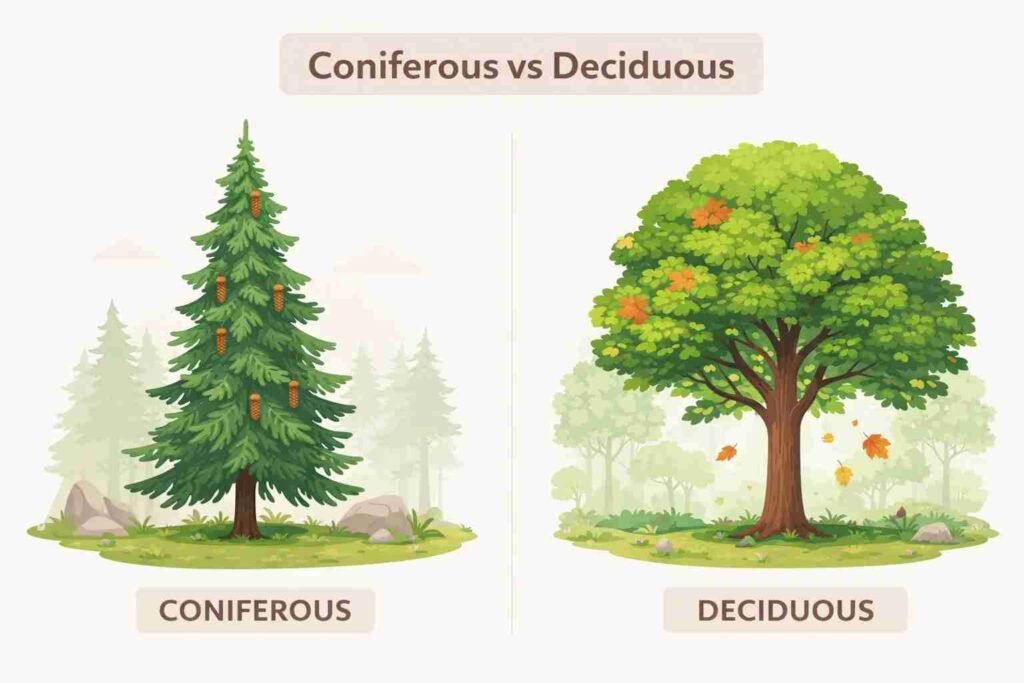
Coniferous trees have needle-like leaves and produce cones. Most of them remain green throughout the year. Deciduous trees have broad leaves and shed them during certain seasons, usually in autumn.
| Feature | Coniferous Trees | Deciduous Trees |
|---|---|---|
| Leaf Type | Needle-like leaves | Broad flat leaves |
| Leaf Cycle | Usually evergreen | Shed leaves seasonally |
| Reproduction | Produce cones | Produce flowers and seeds |
| Climate Preference | Colder climates | Moderate climates |
| Examples | Pine, spruce, fir | Oak, maple, birch |
Definition and Explanation
Coniferous Trees
Coniferous trees belong to a group of plants that reproduce using cones. Their leaves are typically thin and needle shaped, which helps them conserve water and survive cold climates. Because their leaves remain throughout the year, many coniferous trees are called evergreen trees.
These trees are well adapted to environments with long winters and limited water availability. Their needle shaped leaves reduce water loss and allow snow to slide off easily, preventing branch damage.
Common coniferous trees include pine, spruce, cedar, and fir. These trees are widely used in timber production, paper manufacturing, and construction.
Deciduous Trees
Deciduous trees are trees that shed their leaves during a specific season each year. In temperate climates, this usually happens during autumn. The leaves change color before falling, creating the beautiful seasonal landscapes seen in many parts of the world.
The reason deciduous trees shed their leaves is to conserve water and energy during colder months. By dropping leaves, the tree reduces moisture loss when water in the soil becomes limited.
Examples of deciduous trees include oak, maple, elm, birch, and beech. These trees often produce flowers and fruits that support wildlife and contribute to ecosystem diversity.
Characteristics of Coniferous and Deciduous Trees
Understanding their physical characteristics makes it easier to identify these tree types.
Characteristics of Coniferous Trees
• Needle-like leaves
• Cones for reproduction
• Evergreen foliage in most species
• Tall, narrow shape
• Adapted to cold climates
Characteristics of Deciduous Trees
• Broad flat leaves
• Produce flowers and fruits
• Seasonal leaf drop
• Wide branching canopy
• Common in temperate regions
These features reflect how each group has adapted to different environmental conditions.
Advantages and Disadvantages
Advantages of Coniferous Trees
• Able to survive in cold climates
• Provide year round greenery
• Important source of timber and paper
• Require less water due to needle leaves
Disadvantages of Coniferous Trees
• Provide less shade due to narrow shape
• Lower leaf diversity compared to deciduous trees
• Some species grow slower
Advantages of Deciduous Trees
• Provide wide shade during summer
• Support diverse wildlife ecosystems
• Produce fruits and seeds
• Add seasonal beauty with leaf color changes
Disadvantages of Deciduous Trees
• Lose leaves during winter
• Require more water and nutrients
• Leaves require seasonal cleanup in urban areas
Real World Examples
Real world examples make it easier to understand these tree types.
Example of Coniferous Forests
The taiga or boreal forest is the largest land biome on Earth. It is dominated by coniferous trees such as pine and spruce. These forests are found in northern regions including Canada, Russia, and Scandinavia.
These forests play an important role in regulating the global climate because they store large amounts of carbon.
Example of Deciduous Forests
Temperate deciduous forests are common in parts of North America, Europe, and East Asia. Trees like maple, oak, and birch dominate these ecosystems.
During autumn, these forests display vibrant colors such as red, orange, and yellow, attracting tourists and nature enthusiasts.
Regional and Global Distribution
Coniferous and deciduous trees grow in different regions depending on climate and environmental conditions.
North America
North America contains both coniferous and deciduous forests. Canada has extensive coniferous forests, while the eastern United States has large deciduous forests with oak and maple trees.
Europe
Europe contains mixed forests where both coniferous and deciduous trees grow together. Countries such as Germany and Poland have forests that combine pine with oak and beech trees.
Asia
In Asia, Russia contains vast coniferous forests, while China and Japan have large deciduous forests. These ecosystems support diverse wildlife species.
Africa and South America
Tropical regions have fewer classic deciduous forests but still contain trees that shed leaves during dry seasons. Coniferous trees are less common in these regions because of warmer climates.
Common Mistakes
People often misunderstand the differences between coniferous and deciduous trees.
1 Mistake: All coniferous trees are evergreen
While most are evergreen, a few species like larch lose their needles seasonally.
2 Mistake: All deciduous trees lose leaves in winter
Some deciduous trees in tropical regions shed leaves during dry seasons instead of winter.
3 Mistake: Needle leaves mean small trees
Many coniferous trees can grow extremely tall, sometimes over 80 meters.
Correct understanding helps avoid these misconceptions.
Related Concepts and Comparisons
Evergreen vs Deciduous
Evergreen trees keep their leaves year round. Many coniferous trees are evergreen, but evergreen trees are not always conifers.
Hardwood vs Softwood
Deciduous trees usually produce hardwood, which is dense and durable. Coniferous trees often produce softwood, which is lighter and widely used in construction.
| Feature | Hardwood | Softwood |
|---|---|---|
| Source | Mostly deciduous trees | Mostly coniferous trees |
| Density | Higher | Lower |
| Use | Furniture, flooring | Construction, paper |
Exercises with Answers
Exercise 1
Identify whether the following trees are coniferous or deciduous.
1 Pine tree
2 Maple tree
3 Oak tree
4 Spruce tree
Answers
1 Coniferous
2 Deciduous
3 Deciduous
4 Coniferous
Exercise 2
Match the feature with the correct tree type.
| Feature | Tree Type |
|---|---|
| Needle leaves | Coniferous |
| Seasonal leaf drop | Deciduous |
| Cone reproduction | Coniferous |
| Broad leaves | Deciduous |
These exercises help reinforce the differences between the two tree groups.
Environmental Importance
Both coniferous and deciduous forests are vital for maintaining ecological balance.
Coniferous forests play a major role in carbon storage and climate regulation. Their vast coverage across northern regions helps absorb carbon dioxide and regulate temperature.
Deciduous forests support biodiversity by providing habitat for birds, insects, and mammals. Their seasonal leaf fall enriches soil nutrients, supporting plant growth.
Together, these forests contribute to global environmental stability and ecosystem health.
FAQs
What is the main difference between coniferous and deciduous trees?
The main difference is that coniferous trees usually have needle-like leaves and cones, while deciduous trees have broad leaves that fall during certain seasons.
Why do deciduous trees lose their leaves?
Deciduous trees shed leaves to conserve water and energy during cold or dry seasons.
Are all coniferous trees evergreen?
Most coniferous trees are evergreen, but a few species like larch lose their needles during certain seasons.
Which trees grow in colder climates?
Coniferous trees are better adapted to cold climates because their needle leaves reduce water loss and snow damage.
Which trees provide more shade?
Deciduous trees usually provide more shade due to their wide leaves and large canopy.
Do coniferous trees produce flowers?
Coniferous trees produce cones instead of typical flowers.
Why do deciduous leaves change color in autumn?
The color change occurs because chlorophyll breaks down, revealing pigments such as carotenoids and anthocyanins.
Which trees are used more in furniture making?
Deciduous trees provide hardwood, which is commonly used in furniture and flooring.
Which forests store more carbon?
Large coniferous forests such as boreal forests store massive amounts of carbon and help regulate the climate.
Can coniferous and deciduous trees grow together?
Yes, many regions have mixed forests where both tree types grow in the same ecosystem.
Conclusion
Coniferous and deciduous trees represent two major categories of trees that shape forests across the world. Coniferous trees are known for their needle-like leaves, cone reproduction and ability to remain green throughout the year. They are well adapted to colder climates and play a significant role in global carbon storage.
Deciduous trees, on the other hand, are characterized by broad leaves and seasonal leaf loss. They thrive in temperate climates and support diverse ecosystems by providing shade, food and habitat for many species.
Understanding the differences between coniferous and deciduous trees helps us appreciate how plants adapt to different environments. It also highlights the importance of forests in maintaining ecological balance and supporting life on Earth.
By recognizing their unique characteristics, we can better understand forests, protect natural ecosystems and make informed decisions about environmental conservation.
Discover More Related Articles:
- Larkspur vs Delphinium in Gardens: Which One Should You Grow? in 2026
- Iron vs Steamer: Which Is Better for Wrinkle-Free Clothes? in 2026
- Concrete vs Asphalt: Making the Right Choice for Your Project in 2026

David Thompson is the grammar expert behind TalkNexs.com. He believes that learning English grammar doesn’t have to be boring or complicated. Through practical examples and easy explanations, David helps readers understand confusing grammar rules and use them correctly in daily communication. His goal is to make grammar simple, clear and enjoyable for everyone.