
Definition
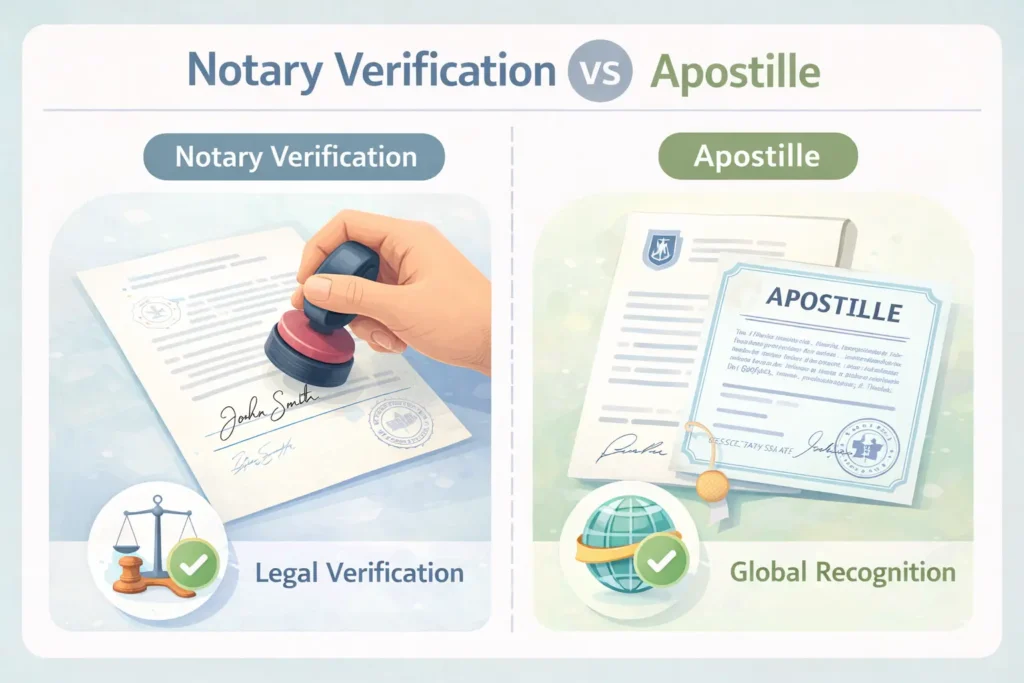
An apostille and a notary both verify documents, but they serve different legal purposes. A notary confirms the authenticity of signatures within a country, while an apostille certifies documents for use in foreign countries that follow the Hague Apostille Convention.
Legal documents often require verification before they can be accepted by government offices, courts, or international institutions. Two common forms of document authentication are notarization and apostille certification.
Although these terms are often used together, they serve very different roles in the legal system. A notary public verifies the identity of individuals signing a document and ensures that the signature is genuine and voluntary.
Confusion between apostille and notary services is common, especially when preparing documents for international use such as education records, birth certificates, marriage certificates, or business agreements. Understanding the difference helps individuals avoid delays, legal complications, and rejected paperwork.
This article explains the differences between apostille and notary services, how each process works, where they are used, and when each type of verification is required. By the end, readers will clearly understand which certification they need for domestic or international documents.
Quick Answer and Overview
A notary verifies the identity of the person signing a document and confirms that the signature is authentic. An apostille certifies that a document or notarization is legitimate so it can be recognized internationally.
| Feature | Notary | Apostille |
|---|---|---|
| Purpose | Verify signatures and identities | Authenticate documents for international use |
| Where Used | Within a country | Between countries in the Hague Apostille Convention |
| Authority | Notary public | Government authority |
| Document Scope | Contracts, affidavits, agreements | Birth certificates, degrees, legal documents |
| Legal Function | Prevent fraud | Enable international recognition |
What Is a Notary
A notary public is an authorized official who verifies the identity of individuals signing legal documents. The notary ensures that the person signing the document is who they claim to be and that they understand the document they are signing.
The process typically includes checking government identification, witnessing the signature, and applying a notary stamp or seal to the document.
Notary services are widely used in many everyday legal and financial transactions.
Common documents that require notarization include
- Affidavits
- Power of attorney documents
- Real estate agreements
- Business contracts
- Loan documents
The primary goal of notarization is to prevent fraud and confirm the authenticity of signatures.
What Is an Apostille
An apostille is a special certification issued by a government authority that authenticates a document for international use. It confirms that a document issued in one country is legitimate and can be accepted in another country that participates in the Hague Apostille Convention.
The apostille verifies the authenticity of the official signature, stamp, or seal on a document.
For example, if someone wants to use a birth certificate from one country in another country for immigration or education purposes, the document may need an apostille.
Documents that often require an apostille include
- Birth certificates
- Marriage certificates
- Academic diplomas
- Business documents
- Court orders
The apostille acts as proof that the document is valid and recognized internationally.
How the Apostille Process Works
The apostille process typically involves several steps.
First, the document must be issued by a recognized authority or notarized by a licensed notary. After that, the document is submitted to a government office authorized to issue apostilles.
This office verifies the authenticity of the signature or seal on the document. Once verified, the office attaches an apostille certificate.
The apostille certificate usually contains
- Country of origin
- Name of the signatory
- Official seal or stamp
- Date of certification
- Signature of the issuing authority
This certification ensures that foreign governments can trust the document.
Advantages and Disadvantages
Advantages of Notary Services
- Helps prevent fraud in legal documents
- Quick and widely available
- Affordable and easy to obtain
- Required for many domestic legal transactions
Disadvantages of Notary Services
- Not sufficient for international document recognition
- Some documents may require additional authentication
Advantages of Apostille Certification
- Enables international document acceptance
- Simplifies authentication between participating countries
- Recognized by many governments worldwide
Disadvantages of Apostille Certification
- Available only for countries in the Hague Apostille Convention
- May require prior notarization or official documentation
- Processing time may vary depending on government offices
Real World Examples
Example one
A student applying to a foreign university may need to submit a diploma. The university may require an apostille to confirm that the diploma is authentic.
Example two
A couple buying property may need to sign a contract that requires notarization. The notary verifies their identity and confirms the signatures.
Example three
A person moving abroad for work might need an apostilled birth certificate or marriage certificate for immigration paperwork.
These examples show how notarization and apostille certification serve different but complementary purposes.
Regional and Global Usage
The use of apostille and notary services varies depending on legal systems and international agreements.
North America
In countries such as the United States and Canada, notary services are widely used for contracts, financial documents, and affidavits. Apostilles are issued by state or federal authorities for documents that must be used internationally.
Europe
Many European countries are members of the Hague Apostille Convention. As a result, apostille certification is commonly used for cross border legal and educational documentation.
Asia
Countries such as Japan and South Korea accept apostilles for international documentation. Some countries that are not part of the convention require additional authentication steps through embassies or consulates.
Middle East
Several Middle Eastern countries require notarization followed by legalization through government ministries and embassies rather than apostilles.
Africa
Some African countries are members of the Hague Convention and accept apostilles, while others require embassy legalization procedures.
Overall, the apostille system simplifies international document authentication for participating countries.
Common Mistakes When Handling Legal Documents
Many individuals face delays because of misunderstandings about notarization and apostille requirements.
Common mistakes include
Submitting a notarized document internationally without an apostille
Assuming that notarization alone makes a document valid overseas
Failing to check whether the destination country accepts apostilles
Not verifying that the document comes from an official authority
These mistakes can cause documents to be rejected or delayed in legal or administrative processes.
Related Concepts and Comparisons
Apostille vs Notary vs Legalization
| Feature | Notary | Apostille | Legalization |
|---|---|---|---|
| Purpose | Verify identity and signature | International certification | Multi step authentication |
| Use | Domestic documents | International documents | Countries outside apostille system |
| Authority | Notary public | Government authority | Embassy or consulate |
| Complexity | Simple | Moderate | Complex |
Exercises With Answers
Exercise One
Identify whether the document requires a notary or an apostille.
1 A business contract signed between two local companies
2 A birth certificate submitted for immigration abroad
3 A power of attorney document signed in a domestic legal case
4 A university diploma used for a foreign job application
Answers
1 Notary
2 Apostille
3 Notary
4 Apostille
Exercise Two
Match the description with the correct certification.
| Description | Certification |
|---|---|
| Verifies identity of signer | Notary |
| Enables international document recognition | Apostille |
| Used for local contracts | Notary |
| Required for documents used abroad | Apostille |
Prevention and Best Practices
When preparing legal documents, following proper procedures can prevent delays.
- Confirm the requirements of the receiving institution or country
- Determine whether notarization alone is sufficient
- Check if the destination country accepts apostilles
- Use certified translators if documents are in another language
- Keep copies of all certified documents
Following these practices ensures smooth legal processing.
FAQs
What is the difference between apostille and notary services?
A notary verifies the identity of a person signing a document, while an apostille certifies the authenticity of a document for international use.
Do all documents need both notarization and apostille certification?
No. Some documents only require notarization, while others require an apostille if they will be used abroad.
Is notarization valid internationally?
Not usually. Most countries require an apostille or legalization for international recognition.
Who issues an apostille certificate?
Government authorities such as state departments, foreign ministries, or designated agencies issue apostilles.
How long does it take to obtain an apostille?
Processing time varies depending on the country and office, but it typically ranges from a few days to several weeks.
Can a notary issue an apostille?
No. A notary can notarize a document, but only authorized government offices can issue an apostille certificate.
Do all countries accept apostilles?
Only countries that are members of the Hague Apostille Convention accept apostille certification.
What happens if a country is not part of the apostille system?
Documents must go through a legalization process involving government and embassy authentication.
Is an apostille permanent?
Yes. Once issued, the apostille remains valid as long as the document itself is valid.
Can digital documents receive apostille certification?
Some countries now allow electronic apostilles for digital documents, depending on local laws.
Conclusion
Apostille and notary services play essential roles in verifying legal documents, but they serve different purposes. A notary confirms the authenticity of signatures and identities in domestic legal transactions, helping prevent fraud and ensuring documents are signed correctly. An apostille, in contrast, certifies that a document is legitimate for use in foreign countries that recognize the Hague Apostille Convention.
Understanding when to use notarization and when to obtain an apostille is important for avoiding delays and ensuring documents are accepted by authorities. Individuals dealing with immigration paperwork, education credentials, international business agreements, or legal documents must carefully verify the requirements of the destination country.
The most effective approach is to confirm document requirements in advance, use licensed notary services when necessary, and obtain apostille certification through authorized government offices.
Discover More Related Articles:
- Nodule vs Papule: How to Tell the Difference in Skin Bumps in 2026
- Apraxia vs Aphasia: How These Speech Disorders Differ in 2026
- Boil vs Abscess: Understanding These Painful Skin Infections in 2026

Christopher Hayes is a passionate language enthusiast and the lead content creator at TalkNexs.com, a platform dedicated to helping readers master the art of grammar, writing and effective communication. With years of experience in writing, editing and teaching language, Christopher’s mission is to make grammar simple, practical and engaging for everyone.