
Definition
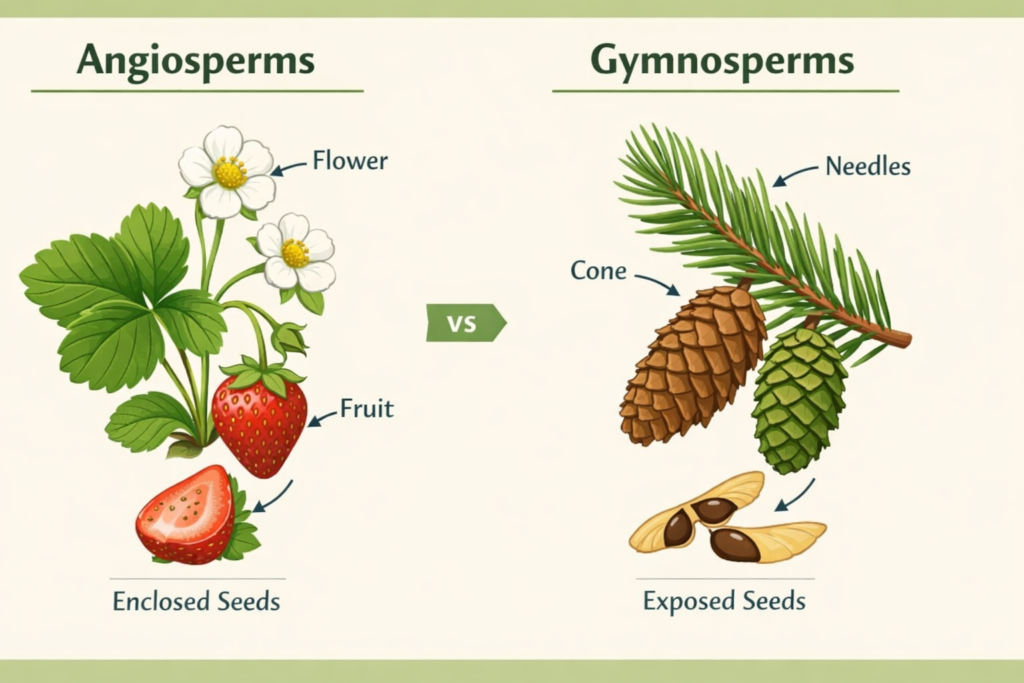
Angiosperms and gymnosperms are two major groups of plants. Angiosperms produce flowers and enclosed seeds, while gymnosperms produce naked seeds without flowers. Understanding their differences helps explain plant evolution, reproduction and diversity in nature.
Plants are essential for life on Earth. They provide oxygen, food, shelter, and support for ecosystems. Among all plant groups, angiosperms and gymnosperms are the most important seed-producing plants. These two groups dominate forests, gardens, farms and natural habitats across the world.
However, many people find it difficult to understand the difference between angiosperms and gymnosperms. Both produce seeds, both grow in similar environments, and both are vital for human survival. Yet, they differ in structure, reproduction, and evolution.
Angiosperms are flowering plants that produce fruits, while gymnosperms are non-flowering plants that produce naked seeds, often in cones. This difference affects how they grow, reproduce, and spread.
In this article, you will learn the definitions, characteristics, advantages, disadvantages, real-world examples, global distribution, and key comparisons between angiosperms and gymnosperms. The goal is to make this topic simple, clear, and useful for students and general readers.
Quick Answer and Overview
Angiosperms and gymnosperms are both seed-producing plants, but they differ mainly in how their seeds are formed and protected.
- Angiosperms produce flowers and seeds enclosed within fruits
- Gymnosperms produce seeds that are exposed or naked, usually in cones
| Feature | Angiosperms | Gymnosperms |
|---|---|---|
| Seeds | Enclosed in fruit | Naked seeds |
| Flowers | Present | Absent |
| Reproduction | Through flowers | Through cones |
| Examples | Mango, rose, wheat | Pine, fir, cedar |
| Diversity | Very high | Lower compared to angiosperms |
Definition and Explanation
Angiosperms
Angiosperms are flowering plants that produce seeds enclosed within a fruit. The word angiosperm means covered seed. These plants use flowers for reproduction. The flower contains male and female parts that help in fertilization. After fertilization, the ovary develops into a fruit that protects the seed.
Angiosperms are the most diverse group of plants, with more than 300,000 species. They include trees, shrubs, grasses, and herbs. Most of the food we eat, such as rice, wheat, fruits, and vegetables, comes from angiosperms.
Gymnosperms
Gymnosperms are non-flowering plants that produce naked seeds. The word gymnosperm means naked seed. These seeds are not enclosed in fruits. Instead, they are usually found on the scales of cones.
Gymnosperms include plants like pine, fir, and spruce. They are often evergreen and grow in colder regions. Their reproduction does not involve flowers, but cones that produce pollen and seeds.
Detailed Characteristics
Characteristics of Angiosperms
- Presence of flowers
- Seeds enclosed within fruits
- Double fertilization process
- Wide variety of forms such as trees, herbs, and grasses
- Efficient water transport system
Characteristics of Gymnosperms
- Absence of flowers
- Seeds are exposed or naked
- Reproduction through cones
- Mostly woody plants
- Adapted to cold and dry climates
Advantages and Disadvantages
Advantages of Angiosperms
- High adaptability to different environments
- Efficient reproduction through pollinators
- Produce fruits that help in seed dispersal
- Provide most human food sources
Disadvantages of Angiosperms
- Dependence on pollinators like insects
- Some species require specific conditions to grow
- Can be affected by seasonal changes
Advantages of Gymnosperms
- Can survive in harsh climates
- Long lifespan
- Require less dependence on animals for pollination
- Evergreen nature allows year-round photosynthesis
Disadvantages of Gymnosperms
- Slower growth compared to angiosperms
- Less diversity
- Seeds are less protected
- Limited methods of seed dispersal
Real-World Examples
- Agriculture: Crops like rice, wheat, and corn are angiosperms and form the basis of human diets
- Forestry: Pine and fir trees are gymnosperms used for timber and paper production
- Gardening: Flowering plants like roses and sunflowers are angiosperms
- Cold Regions: Conifer forests are dominated by gymnosperms
Regional and Global Usage
Angiosperms and gymnosperms are found across the globe, but their distribution depends on climate, soil, and environmental conditions.
Tropical Regions
Angiosperms dominate tropical forests due to warm temperatures and high rainfall. Trees, flowering plants, and crops thrive in these regions. Countries in South Asia, Africa, and South America rely heavily on angiosperms for food and agriculture.
Temperate Regions
Both angiosperms and gymnosperms are found in temperate regions. Deciduous trees such as oak and maple are angiosperms, while coniferous trees like pine are gymnosperms. These regions show seasonal changes that affect plant growth.
Cold Regions
Gymnosperms dominate cold climates such as northern Europe, Canada, and Siberia. Their needle-like leaves and evergreen nature help them survive snow and low temperatures.
Desert Regions
Some angiosperms adapt to dry conditions, but gymnosperms are less common in deserts. Specialized angiosperms with water storage systems survive better in such environments.
Globally, angiosperms are more widespread and diverse, while gymnosperms are more specialized and adapted to specific environments.
Common Mistakes
| Mistake | Why It Is Incorrect | Correct Understanding |
|---|---|---|
| Thinking all plants have flowers | Gymnosperms do not have flowers | Only angiosperms produce flowers |
| Assuming all seeds are inside fruits | Gymnosperms have naked seeds | Only angiosperms enclose seeds |
| Confusing cones with fruits | Cones are reproductive structures, not fruits | Fruits develop from flowers |
| Believing gymnosperms are less important | They are vital for ecosystems and industry | Both groups are important |
Exercises with Answers
Exercise 1
Identify the following plants are angiosperms or gymnosperms
- Mango tree
- Pine tree
- Rose plant
- Fir tree
Answers
- Angiosperm
- Gymnosperm
- Angiosperm
- Gymnosperm
Exercise 2
Match the feature with the correct plant group
| Feature | Angiosperm | Gymnosperm |
|---|---|---|
| Produces flowers | Yes | No |
| Seeds in cones | No | Yes |
| Seeds in fruit | Yes | No |
| Evergreen nature | Sometimes | Mostly |
Related Concepts and Comparisons
Angiosperms vs Gymnosperms vs Ferns
| Feature | Angiosperms | Gymnosperms | Ferns |
|---|---|---|---|
| Seeds | Yes | Yes | No |
| Flowers | Yes | No | No |
| Reproduction | Seeds in fruits | Naked seeds | Spores |
| Complexity | High | Medium | Lower |
Ferns are more early plants that reproduce through spores, unlike seed-producing angiosperms and gymnosperms.
Importance in Ecosystem
- Angiosperms provide food, oxygen, and habitat for animals
- Gymnosperms support forest ecosystems and provide shelter
- Both groups contribute to the carbon cycle and climate balance
- They help prevent soil erosion and maintain biodiversity
FAQs
What is the main difference between angiosperms and gymnosperms?
Angiosperms have flowers and enclosed seeds, while gymnosperms have naked seeds and no flowers.
Which is more advanced, angiosperms or gymnosperms?
Angiosperms are considered more advanced due to complex reproductive systems.
Do gymnosperms produce fruits?
No, gymnosperms do not produce fruits because they lack flowers.
Why are angiosperms more diverse?
Their efficient reproduction and adaptability allow them to grow in many environments.
Where are gymnosperms commonly found?
They are mostly found in cold and temperate regions.
Can angiosperms survive in cold climates?
Yes, many angiosperms adapt to seasonal changes in temperate regions.
What role do angiosperms play in human life?
They provide food, medicine, and raw materials.
Are all evergreen plants gymnosperms?
No, some angiosperms are also evergreen.
Do gymnosperms need pollinators?
They mainly rely on wind for pollination.
Why are gymnosperms important?
They provide timber, paper, and support ecosystems in cold regions.
Conclusion
Angiosperms and gymnosperms are two major groups of seed-producing plants that play a vital role in life on Earth. Angiosperms produce flowers and fruits, making them highly diverse and essential for food production. Gymnosperms, on the other hand, produce naked seeds and are well adapted to harsh environments.
Understanding the differences between these two groups helps explain plant evolution, ecological balance, and agricultural importance. Angiosperms dominate most ecosystems due to their adaptability, while gymnosperms thrive in specific climates like cold regions.
For practical understanding, always remember that flowers and fruits indicate angiosperms, while cones and naked seeds indicate gymnosperms. By recognizing these features, students and readers can easily identify and classify plants in real life.
Discover More Related Articles:
- Calm vs Headspace: Which Is Better for Sleep, Anxiety and Focus in 2026
- Sleeve vs Bypass: Which Weight Loss Surgery Is Right for You In 2026
- Cancun vs Tulum: Where to Stay, Eat and Explore in 2026

David Thompson is the grammar expert behind TalkNexs.com. He believes that learning English grammar doesn’t have to be boring or complicated. Through practical examples and easy explanations, David helps readers understand confusing grammar rules and use them correctly in daily communication. His goal is to make grammar simple, clear and enjoyable for everyone.