
Defintion
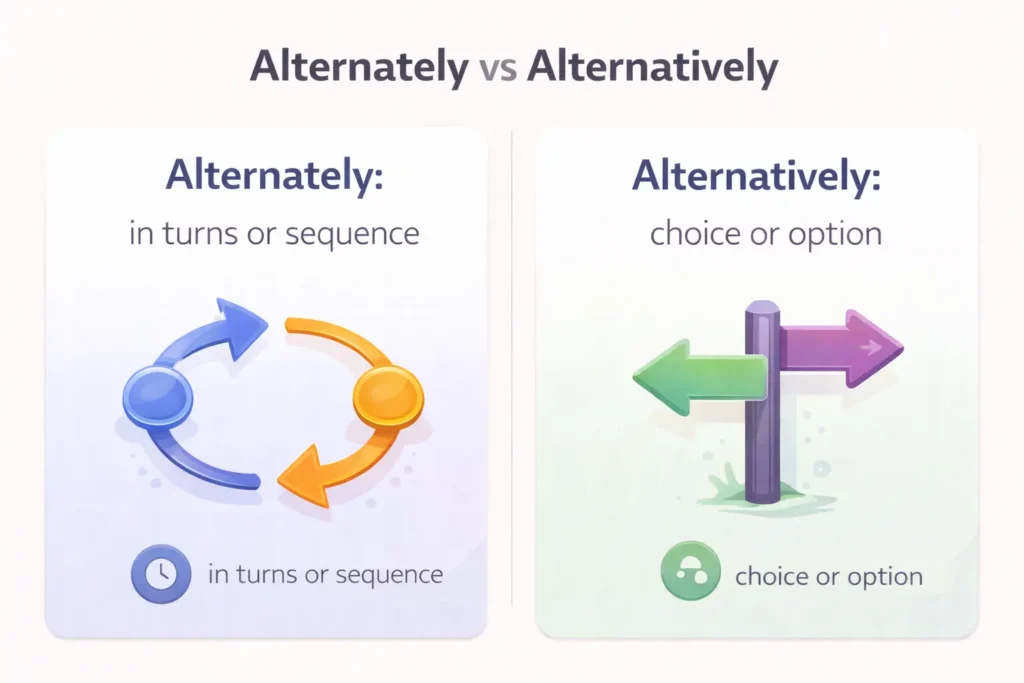
“Alternately” and “alternatively” are often confused in English. “Alternately” refers to something happening in turns, while “alternatively” presents an option or choice. Correct usage ensures clarity and precision in writing.
English is a rich and nuanced language, but it can also be tricky. Words that look or sound similar often confuse writers and speakers. One common pair is alternately and alternatively. Many people use these words interchangeably, but they have distinct meanings and applications. Misusing them can make sentences unclear or grammatically incorrect.
Alternately describes actions or events occurring in turn or one after the other. For example, “The red and blue lights flashed alternately.” It emphasizes sequence or rotation.
Alternatively, on the other hand, introduces a choice, option, or substitute. For instance, “You can walk to the park; alternatively, you can take the bus.” It emphasizes alternatives rather than sequence.
In this article, we will explore definitions, differences, real-world examples, common mistakes, exercises, related concepts, and global usage of alternately vs alternatively. By the end, you will know how to use each word correctly, enhance your writing, and avoid common pitfalls.
Quick Overview
| Word | Meaning | Example |
|---|---|---|
| Alternately | Occurring in turns or succession | The students spoke alternately in English and French. |
| Alternatively | Presenting a choice or option | We can go to the beach. Alternatively, we can visit the museum. |
- Key Difference: Alternately is about rotation or sequence, alternatively is about choices or options.
- Misusing these words can cause confusion in both spoken and written English.
Definition and Explanation
Alternately
Alternately is an adverb that means something happens one after the other or in turns. It emphasizes a repeated pattern or rotation.
Examples:
- The lights on the stage flashed alternately red and blue.
- Students were asked to answer questions alternately.
- The team members alternately led discussions on each topic.
In each case, alternately indicates a sequence or a back-and-forth pattern.
Alternatively
Alternatively is an adverb used to present a choice, option, or substitute. It signals that there is another possibility or course of action.
Examples:
- You can finish the project today; alternatively, you can submit it tomorrow.
- We could eat at the new restaurant. Alternatively, we could order takeout.
- You might take the train. Alternatively, you may drive to save time.
Here, alternatively introduces an option that a person can choose instead of the first.
Differences Between Alternately and Alternatively
| Feature | Alternately | Alternatively |
|---|---|---|
| Definition | Happening in turns or in succession | Presenting a choice or option |
| Function | Describes sequence | Offers an alternative |
| Usage | Emphasizes rotation or back-and-forth | Emphasizes possibility or choice |
| Example | The traffic lights flashed alternately | You can stay home; alternatively, you can join us |
| Common Confusion | Often misused to indicate choice | Often misused to indicate sequence |
Real-World Examples
Alternately
- Sports: In a tennis match, players serve alternately.
- Classroom: Students read alternately to practice fluency.
- Workplace: Team members alternately presented their reports.
Alternatively
- Travel: You can drive to the city; alternatively, you can take the train.
- Dining: We could try Italian food. Alternatively, we could go for sushi.
- Projects: Submit your report now. Alternatively, you can request an extension.
These examples illustrate how each word functions in real-life contexts.
Common Mistakes
| Mistake | Why It’s Wrong | Correct Version |
|---|---|---|
| Using “alternately” to indicate options | Alternately refers to sequence, not choice | You can walk; alternatively, you can bike |
| Using “alternatively” to show rotation | Alternatively signals choice, not sequence | The students spoke alternately in English and French |
| Mixing both in formal writing | Can confuse readers | Use the correct word based on context |
Exercises with Answers
Exercise 1: Choose the correct word for each sentence.
- The children stood in line, taking turns _______.
- You can call her now; _______, you can send an email.
- The flags waved _______ in red, white, and blue.
- We could go to the library; _______, we could visit the park.
Answers:
- Alternately
- Alternatively
- Alternately
- Alternatively
Exercise 2: Correct the mistakes in the following sentences.
- You can alternately take a taxi or walk to the station.
- The dancers moved alternatively, left and right.
Answers:
- You can alternatively take a taxi or walk to the station.
- The dancers moved alternately, left and right.
Regional and Global Usage
The confusion between alternately and alternatively is common among English learners worldwide. Usage varies depending on education, exposure, and language teaching methods.
- North America and Europe: Formal writing emphasizes correct usage. Educational materials and style guides provide clear definitions to prevent mistakes.
- Asia: English learners in countries like India, China, and Japan often confuse the words due to translation issues. Teachers and online courses increasingly focus on the distinction.
- Latin America: English is learned mostly as a second language, and alternately vs alternatively mistakes appear in exams and writing.
- Africa: Exposure to English through schools and media helps reduce confusion, though mistakes still occur in informal communication.
Globally, digital tools, online courses, and grammar-checking software have made it easier for learners to identify and correct misuses of these words. Social media content, business communication, and academic writing increasingly emphasize correct usage for clarity.
Related Concepts and Comparisons
Alternately vs In Turn
- Alternately focuses on sequence, back-and-forth actions.
- “In turn” has a similar meaning but emphasizes order more formally.
Example:
- Students spoke alternately.
- Students spoke in turn.
Alternatively vs Or Else
- Alternatively introduces a choice politely or formally.
- “Or else” can indicate consequence, often informal or negative.
Example:
- You can submit your assignment by Friday; alternatively, you may request an extension.
- Submit your assignment by Friday, or else you will fail.
Tips for Correct Usage
- Check the context: Sequence or rotation? Use alternately. Choice or substitute? Use alternatively.
- Replace with simpler words: If unsure, use “one after another” instead of alternately and “or instead” instead of alternatively.
- Read aloud: Hearing the sentence can reveal if the meaning makes sense.
- Practice with examples: Writing multiple sentences using both words helps internalize the difference.
FAQs
What is the difference between alternately and alternatively?
Alternately describes sequence or rotation. Alternatively introduces a choice or option.
Can I use alternately instead of alternatively?
No. Alternately refers to a sequence, not options. Using it incorrectly confuses readers.
Can alternatively be used to describe turns?
No. Alternatively indicates an alternative, not order or rotation.
Is it formal or informal to use either word?
Both words are formal and acceptable in professional and academic writing, but they must be used correctly.
How common is this mistake?
Very common among English learners and even native speakers. Online usage and style guides emphasize correct usage.
Can I replace alternately with every other?
Yes. “Every other” can often convey the same sequence meaning as alternately.
Is alternatively interchangeable with or instead?
Often yes. “Or instead” is simpler and conveys the same alternative meaning.
Are there mnemonic tips to remember the difference?
Think of alternately as alternating actions and alternatively as offering an alternative option.
Conclusion
Alternately and alternatively are words that are often confused but have distinct meanings. Alternately refers to actions occurring in turns or sequence, while alternatively introduces choices or options. Misusing these words can make writing unclear or ambiguous. Alternately vs alternatively.
Using context, simple replacements, and careful editing ensures correct usage. Practice with exercises, read examples, and consider mnemonics to remember the difference.
Proper usage improves clarity in writing, enhances communication skills and avoids misunderstandings. Understanding alternately vs alternatively is a small but significant step toward precise, professional English.
Discover More Related Articles:
- P790 vs P770: Which Taylor Made Iron Is Better for Your Golf Game? in 2026
- Tiguan vs Taos: Which Volkswagen SUV Should You Choose? in 2026
- Titanium vs Tungsten: Which Metal Is Best for Jewelry and Rings? in 2026

Christopher Hayes is a passionate language enthusiast and the lead content creator at TalkNexs.com, a platform dedicated to helping readers master the art of grammar, writing and effective communication. With years of experience in writing, editing and teaching language, Christopher’s mission is to make grammar simple, practical and engaging for everyone.