
Definition
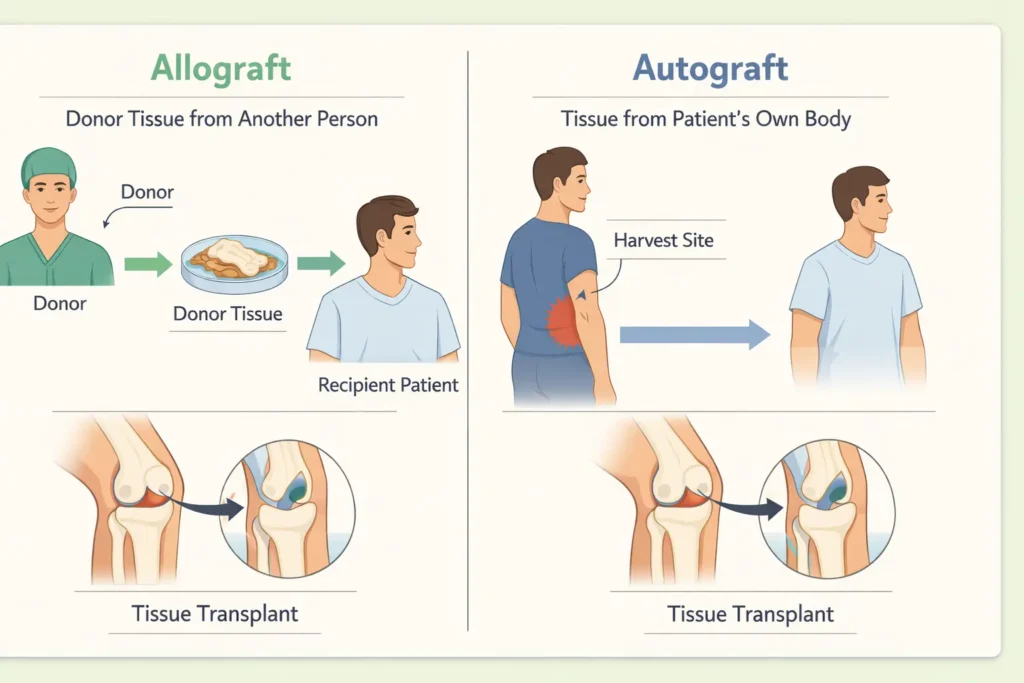
Allograft and autograft are two types of tissue grafts used in medical procedures. An allograft comes from a donor, while an autograft uses tissue from the patient’s own body. Understanding their differences helps in choosing the safest and most effective treatment option.
In modern medicine, tissue grafting plays a vital role in treating injuries, repairing damaged tissues, and improving recovery outcomes. Two commonly used grafting methods are allograft and autograft. While both serve the same purpose, which is to replace or repair damaged tissue, they differ significantly in source, risk, recovery, and effectiveness.
Many patients face confusion when doctors recommend one option over the other. Questions often arise about safety, healing time, risk of rejection, and long-term results. Choosing the right graft type is important because it can affect recovery speed, complications, and overall success of the procedure.
Allograft uses tissue from a donor, often processed and stored in tissue banks. Autograft, on the other hand, uses tissue taken from the patient’s own body. Each method has unique advantages and disadvantages depending on the medical condition, patient health, and surgical goals.
This article explains the differences between allograft and autograft in simple terms. It covers definitions, uses, benefits, risks, real-world applications, and expert recommendations to help you understand which option may be more suitable.
Quick Answer and Overview
Allograft and autograft differ mainly in the source of the tissue used in grafting procedures.
- Allograft: Tissue taken from another person
- Autograft: Tissue taken from the same patient
| Feature | Allograft | Autograft |
|---|---|---|
| Source | Donor | Patient’s own body |
| Risk of Rejection | Possible | Very low |
| Healing Time | Moderate | Faster |
| Surgical Complexity | Single surgery | Two surgical sites |
| Availability | Readily available | Limited |
| Infection Risk | Slightly higher | Lower |
Definition and Explanation
What is an Allograft
An allograft is a tissue graft taken from a donor of the same species. The donor may be living or deceased. These tissues are carefully processed, sterilized, and stored in tissue banks before use.
Allografts are commonly used in orthopedic surgeries such as ligament repair, bone reconstruction, and dental procedures. Because the tissue comes from another person, the body may recognize it as foreign, which can lead to immune response or rejection in some cases.
However, modern processing techniques significantly reduce these risks. Allografts are widely used because they eliminate the need for a second surgical site.
What is an Autograft
An autograft is a tissue graft taken from the patient’s own body. Common donor sites include the thigh, hip, or other areas depending on the procedure.
Autografts are considered the gold standard in many surgeries because they have the highest compatibility. Since the tissue comes from the same individual, the risk of rejection is extremely low.
Autografts are frequently used in procedures such as ligament reconstruction, bone grafting, and skin grafting for burns. While they provide excellent results, they require an additional surgical site, which may increase pain and recovery time.
Advantages and Disadvantages
Advantages of Allograft
- No need for a second surgical site
- Reduced operation time
- Less initial pain compared to autograft
- Useful when large amounts of tissue are needed
Disadvantages of Allograft
- Risk of immune rejection
- Slight risk of disease transmission
- Slower integration with the body
- May be less durable in some cases
Advantages of Autograft
- No risk of rejection
- Faster healing and integration
- Stronger and more reliable outcomes
- Lower risk of infection
Disadvantages of Autograft
- Requires additional surgery
- Increased pain at donor site
- Limited tissue availability
- Longer surgical time
Real-World Examples
- Knee Ligament Repair: Athletes often undergo anterior cruciate ligament reconstruction. Autografts are commonly used for better strength and recovery.
- Dental Bone Grafting: Allografts are frequently used to rebuild bone for dental implants.
- Burn Treatment: Skin autografts are preferred because they integrate well and reduce rejection risk.
- Spinal Surgery: Both allografts and autografts are used depending on the patient’s condition and surgeon preference.
Studies show that autografts have a slightly higher success rate in high-performance athletes, while allografts are preferred in less demanding cases or when avoiding additional surgery is important.
Regional and Global Usage
Allograft and autograft procedures are widely practiced across the world, but their usage varies depending on healthcare systems, cultural factors, and medical resources.
North America and Europe
Advanced healthcare systems use both graft types extensively. Tissue banks supply high-quality allografts, while autografts are preferred for critical procedures.
Asia
Countries focus on cost-effective treatments. Autografts are commonly used due to lower cost and higher acceptance.
Middle East
Modern hospitals use both methods, with increasing reliance on allografts due to improved tissue banking facilities.
Africa and Developing Regions
Autografts are more common due to limited access to donor tissue and tissue banks.
Globally, the use of allografts is increasing due to advancements in sterilization and storage technology.
Common Mistakes
- Assuming allografts are unsafe
- Ignoring donor site pain in autografts
- Choosing graft type without considering lifestyle
- Believing all procedures have the same recovery time
Correct decision-making requires consultation with a qualified medical professional.
Exercises with Answers
Exercise 1: Identify the type of graft
- Tissue taken from the patient’s own body
- Tissue taken from a donor
- Higher risk of rejection
- No second surgical site
Answers
- Autograft
- Allograft
- Allograft
- Allograft
Exercise 2: Match the features
| Feature | Allograft | Autograft |
|---|---|---|
| No rejection risk | No | Yes |
| Donor tissue | Yes | No |
| Faster healing | No | Yes |
| No second surgery | Yes | No |
Related Concepts and Comparisons
Allograft vs Autograft vs Xenograft
| Feature | Allograft | Autograft | Xenograft |
|---|---|---|---|
| Source | Human donor | Same person | Animal |
| Rejection Risk | Moderate | Low | High |
| Use | Common | Very common | Specialized |
Allograft vs Synthetic Grafts
Synthetic grafts are artificial materials used when biological grafts are not suitable. They eliminate donor issues but may lack natural integration.
Prevention and Decision Factors
Choosing between allograft and autograft depends on several factors:
- Patient age and health
- Activity level
- Type of surgery
- Availability of donor tissue
- Surgeon experience
Patients should discuss risks and benefits with their doctor before making a decision.
FAQs
What is the main difference between allograft and autograft?
Allograft uses donor tissue, while autograft uses tissue from the patient’s own body.
Which is safer, allograft or autograft?
Autograft is generally safer due to no rejection risk, but both are safe when properly handled.
Does allograft have a risk of disease transmission?
Yes, but the risk is extremely low due to strict screening and sterilization.
Why do doctors choose allograft?
To avoid additional surgery and reduce recovery time in some cases.
Why is autograft considered the gold standard?
Because it integrates better and has no rejection risk.
Which graft heals faster?
Autograft usually heals faster due to better compatibility.
Is allograft less painful?
Yes, because it does not require a second surgical site.
Can allografts fail?
Yes, but modern techniques have improved success rates significantly.
Are both options expensive?
Costs vary, but allografts may be more expensive due to processing and storage.
How do I choose between allograft and autograft?
Consult your doctor based on your condition, lifestyle, and medical needs.
Conclusion
Allograft and autograft are essential techniques in modern medicine, each offering unique advantages. Allografts provide convenience and eliminate the need for a second surgical site, making them suitable for many patients. Autografts, however, remain the gold standard due to their compatibility, lower rejection risk, and faster healing.
Choosing the right graft depends on several factors, including the type of surgery, patient health, and recovery goals. Patients should carefully evaluate their options and consult with medical professionals to make informed decisions.
With advancements in medical technology, both allograft and autograft procedures continue to improve, offering safer and more effective outcomes. Understanding their differences helps patients achieve better recovery and long-term success.
Discover More Related Articles:
- Etiology vs Pathophysiology: Why Both Matter in Healthcare in 2026
- Headspace vs Calm: Which Meditation App Is Worth Your Money in 2026
- Outcall vs Incall: Which One Is More Convenient and Why in 2026

Christopher Hayes is a passionate language enthusiast and the lead content creator at TalkNexs.com, a platform dedicated to helping readers master the art of grammar, writing and effective communication. With years of experience in writing, editing and teaching language, Christopher’s mission is to make grammar simple, practical and engaging for everyone.